
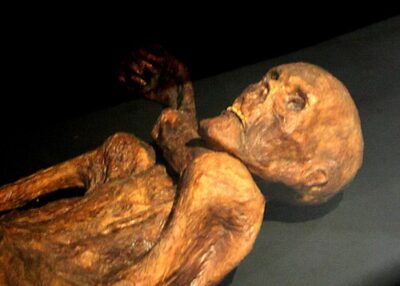
Ötzi
Ötzi was a well-preserved natural prehistoric mummy. Born 3275 BC, in Feldthurns. Died 3230 BC, in Tisenjoch.
Facts
11 facts · 0 confirmed by two sources · 1 cited · 10 from one source
Where this comes from
Papalocal keeps its own record. It started from these sources; what each one said is kept here as it was copied, so a change on their side never changes this page by itself. Tap one to read its version.
What Wikidata says · copied November 16, 2026 · revision 2562461496
- Described as
- well-preserved natural prehistoric mummy
- Other names
- Similaun Man, Man from Hauslabjoch, Homo tyrolensis, Hauslabjoch mummy, Ötzi the Iceman, Tisenjoch mummy, Man from Tisenjoch, Tyrolean Ice Man, Tyrolean IceMan, Tyrolean Iceman, Otzi, Otzi þe Iceman
- Born
- 3275 BC
- Died
- 3230 BC
- Born in
- Feldthurns
- Died in
- Tisenjoch
- Buried in
- South Tyrol Museum of Archaeology (1998–)
- Cause of death
- exsanguination
- Nickname
- Ötzi the Iceman · 1 reference; Similaun Man; Man from Hauslabjoch; Tyrolean Iceman
- Website
- https://iceman.it
- Wikipedias with a page
- 69
Wikidata item Q171291 (wikidata.org/wiki/Q171291), public domain (CC0). Copied November 16, 2026.
What Wikipedia says · copied November 16, 2026 · revision 1385705519
"Ötzi" (German: [œtsi]; c. 3275 BC – c. 3230 BC), also called the Iceman, Similaun man, or Tyrolean Iceman, is the natural mummy of a man who lived during the 4th millennium BC. Ötzi's remains were discovered on 19 September 1991, on the Italian side of the Ötztal Alps (hence the nickname "Ötzi"), merely 93 meters or 102 yards south of the Austria-Italy border. He is Europe's oldest known natural human mummy, showing an unprecedented view of Chalcolithic (Copper Age) Europeans.
Because of the presence of an arrowhead embedded in his left shoulder and various other wounds, researchers believe that Ötzi was killed by another person. The nature of his life and the circumstances of his death are the subject of much investigation and speculation. His remains and personal belongings are on exhibit at the South Tyrol Museum of Archaeology in Bolzano, South Tyrol, Italy.
From the Wikipedia article “Ötzi” (en.wikipedia.org/wiki/Ötzi), by its contributors, under CC BY-SA 4.0 (creativecommons.org/licenses/by-sa/4.0/). Copied November 16, 2026; not changed.
Confirmed Two sources agree. Cited One source, and it names where it got it. One source One source, without a reference of its own. Sources disagree The sources disagree. We show the best-supported value and keep theirs below.
