
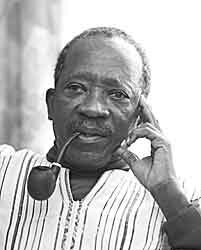
Ousmane Sembène
Ousmane Sembène was a Senegalese film director, producer, screenwriter, actor, and author. Born January 1, 1923, in Ziguinchor. Died June 9, 2007, in Dakar. Known for God's Bits of Wood, Black Girl and Mandabi. Educated at Gerasimov Institute of Cinematography. Awards include Officer of the Legion of Honour, Carrosse d'or and Prix Jean Vigo.
Facts
30 facts · 1 confirmed by two sources · 15 cited · 13 from one source · 1 where the sources disagree
What’s different
- Died: we show June 9, 2007 (Sources disagree). Wikipedia says January 8, 1923
Where this comes from
Papalocal keeps its own record. It started from these sources; what each one said is kept here as it was copied, so a change on their side never changes this page by itself. Tap one to read its version.
What Wikidata says · copied November 16, 2026 · revision 2558204198
- Described as
- Senegalese film director, producer, screenwriter, actor, and author (1923–2007)
- Other names
- Ousmane Sembene, Father of African Cinema, Sembene Ousmane
- Born
- January 1, 1923 · 5 references
- Died
- June 9, 2007 · 10 references
- Born in
- Ziguinchor · 1 reference
- Died in
- Dakar · 3 references
- Buried in
- Yoff
- Citizen of
- Senegal · 2 references
- Occupation
- film director · 3 references; film producer · 1 reference; actor · 1 reference; playwright; screenwriter; stevedore · 3 references; political activist · 1 reference; prose writer · 1 reference
- Political party
- French Communist Party (1950) · 2 references
- Education
- Gerasimov Institute of Cinematography (1961–)
- Known for
- God's Bits of Wood · 1 reference; Black Girl; Mandabi; Xala; Ceddo; Moolaadé; Borom Sarret
- Awards
- Officer of the Legion of Honour (2006); Carrosse d'or (2005) · 1 reference; Prix Jean Vigo (1966) · 1 reference; Un Certain Regard (2004); Grand prix littéraire en poésie d'Afrique noire (1997) · 1 reference; Tanit d'or (1966)
- Military branch
- Senegalese Tirailleurs · 2 references
- Wikipedias with a page
- 50
Wikidata item Q314966 (wikidata.org/wiki/Q314966), public domain (CC0). Copied November 16, 2026.
What Wikipedia says · copied November 16, 2026 · revision 1371381496
Ousmane Sembène (French: [usman sɑ̃bɛn]; 1 January 1923 or 8 January 1923 – 9 June 2007), was a Senegalese film director, producer and writer. The Los Angeles Times considered him one of the greatest authors of Africa and he has often been called the "father of African film".
He was often credited for his work in the French style as Sembène Ousmane, which he seemed to favor as a way to underscore the "colonial imposition" of this naming ritual and subvert it.
Descended from a Serer family through his mother from the line of Matar Sène, Ousmane Sembène was particularly drawn to Serer religious festivals. He especially was intrigued by the Tuur festival.
- Born, in its opening lines
- January 1, 1923
- Died, in its opening lines
- January 8, 1923
From the Wikipedia article “Ousmane Sembène” (en.wikipedia.org/wiki/Ousmane_Sembène), by its contributors, under CC BY-SA 4.0 (creativecommons.org/licenses/by-sa/4.0/). Copied November 16, 2026; not changed.
Confirmed Two sources agree. Cited One source, and it names where it got it. One source One source, without a reference of its own. Sources disagree The sources disagree. We show the best-supported value and keep theirs below.
