
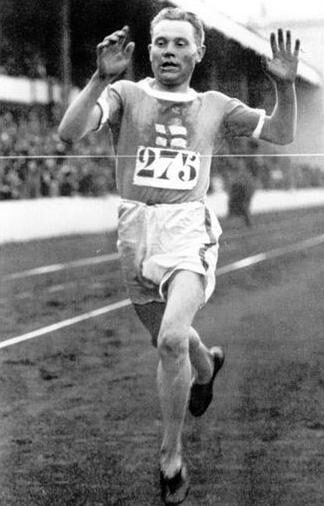
Paavo Nurmi
Paavo Nurmi was a Finnish middle and long distance runner. Born June 13, 1897, in Turku. Died October 2, 1973, in Helsinki. Teams include Turun Urheiluliitto (1914–1934). Awards include Knight First Class of the Order of the White Rose of Finland, The Great Cross of Merit of Finnish Sports and Culture of Physical Exercise and Knight First Class of the Order of the Lion of Finland.
Facts
23 facts · 2 confirmed by two sources · 11 cited · 10 from one source
Where this comes from
Papalocal keeps its own record. It started from these sources; what each one said is kept here as it was copied, so a change on their side never changes this page by itself. Tap one to read its version.
What Wikidata says · copied November 16, 2026 · revision 2569074036
- Described as
- Finnish middle and long distance runner (1897–1973)
- Other names
- Paavo Johannes Nurmi
- Born
- June 13, 1897 · 10 references
- Died
- October 2, 1973 · 7 references
- Born in
- Turku · 2 references
- Died in
- Helsinki · 3 references
- Buried in
- Turku Cemetery
- Name at birth
- Paavo Johannes Nurmi
- Citizen of
- Finland (1917–) · 1 reference; Grand Duchy of Finland (–1917)
- Occupation
- long-distance runner; marathon runner; athletics competitor · 1 reference; athlete · 1 reference
- Teams
- Turun Urheiluliitto (1914–1934)
- Sport
- athletics
- Instrument
- violin · 1 reference
- Awards
- Knight First Class of the Order of the White Rose of Finland (1925) · 1 reference; The Great Cross of Merit of Finnish Sports and Culture of Physical Exercise (1947) · 1 reference; Knight First Class of the Order of the Lion of Finland (1967) · 1 reference; Finnish Olympic Cross of Merit, First Class (1952) · 1 reference; First Class Medal of the Order of the White Rose of Finland (1920) · 1 reference; IAAF Hall of Fame (2012) · 1 reference
- Lived in
- Turku
- Height
- 1.74 m (5 ft 9 in)
- Wikipedias with a page
- 70
Wikidata item Q101942 (wikidata.org/wiki/Q101942), public domain (CC0). Copied November 16, 2026.
What Wikipedia says · copied November 16, 2026 · revision 1380640809
Paavo Johannes Nurmi (Finnish pronunciation: [ˈpɑːʋo ˈnurmi] ; 13 June 1897 – 2 October 1973) was a Finnish middle-distance and long-distance runner. He was called the "Flying Finn" because he dominated distance running in the 1920s. Nurmi set 22 official world records at distances between 1,500 metres and 20 kilometres, and won nine gold and three silver medals in his 12 events in the Summer Olympic Games. At his peak, Nurmi was undefeated for 121 races at distances from 800 m upwards. Throughout his 14-year career, he remained unbeaten in cross country events and the 10,000 metres.
Born into a working-class family, Nurmi left school at the age of 12 to provide for his family. In 1912, he was inspired by the Olympic feats of Hannes Kolehmainen and began developing a strict training program. Nurmi started to flourish during his military service, setting Finnish records in athletics en route to his international debut at the 1920 Summer Olympics. After winning a silver medal in the 5,000 m, he won gold in the 10,000 m and the cross country events. In 1923, Nurmi became the first runner to hold simultaneous world records in the mile, the 5,000 m and the 10,000 m races, a feat which has never been repeated. He set new world records for the 1,500 m and the 5,000 m with just an hour between the races, and took gold medals in both distances in less than two hours at the 1924 Summer Olympics. Seemingly unaffected by the Paris heat wave, Nurmi won all his races and returned home with five gold medals, although he was frustrated that Finnish officials had refused to enter him for the 10,000 m.
Struggling with injuries and motivation issues after his exhaustive U.S. tour in 1925, Nurmi found his long-time rivals compatriot Ville Ritola and Sweden's Edvin Wide ever more serious challengers. At the 1928 Summer Olympics, Nurmi recaptured the 10,000 m title but was beaten for the gold in the 5,000 m and the 3,000 m steeplechase. He then turned his attention to longer distances, breaking the world records for events such as the one hour run and the 25-mile marathon. Nurmi intended to end his career with a marathon gold medal, as his idol Kolehmainen had done. In a controversial case that strained Finland–Sweden relations and sparked an inter-IAAF battle, Nurmi was suspended before the 1932 Games by an IAAF council that questioned his amateur status; two days before the opening ceremonies, the council rejected his entries. Although he was never declared a professional, Nurmi's suspension became definite in 1934 and he retired from running.
Nurmi later coached Finnish runners, raised funds for Finland during the Winter War, and worked as a haberdasher, building contractor and in the financial sector, becoming one of the richest people in Finland. In 1952, he was the lighter of the Olympic Flame at the Summer Olympics in Helsinki. Nurmi's running speed and elusive personality spawned nicknames such as the "Phantom Finn", while his achievements, training methods and running style influenced future generations of middle- and long-distance runners. Nurmi, who rarely ran without a stopwatch in his hand, has been credited with introducing the "even pace" strategy and analytic approach to running, and for making running a major international sport.
- Born, in its opening lines
- June 13, 1897
- Died, in its opening lines
- October 2, 1973
From the Wikipedia article “Paavo Nurmi” (en.wikipedia.org/wiki/Paavo_Nurmi), by its contributors, under CC BY-SA 4.0 (creativecommons.org/licenses/by-sa/4.0/). Copied November 16, 2026; not changed.
Confirmed Two sources agree. Cited One source, and it names where it got it. One source One source, without a reference of its own. Sources disagree The sources disagree. We show the best-supported value and keep theirs below.
