
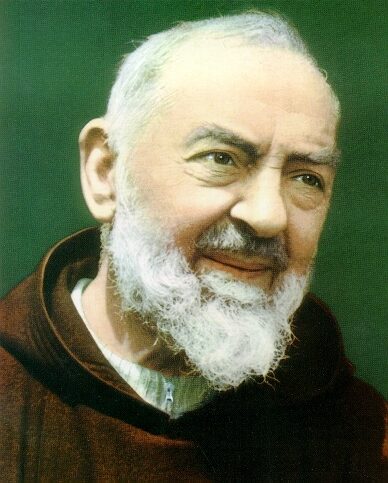
Padre Pio
Padre Pio was an Italian saint, priest, stigmatist and mystic. Born May 25, 1887, in Pietrelcina. Died September 23, 1968, in San Giovanni Rotondo.
Facts
17 facts · 2 confirmed by two sources · 10 cited · 5 from one source
Where this comes from
Papalocal keeps its own record. It started from these sources; what each one said is kept here as it was copied, so a change on their side never changes this page by itself. Tap one to read its version.
What Wikidata says · copied November 16, 2026 · revision 2558204767
- Described as
- Italian saint, priest, stigmatist and mystic
- Other names
- Pio, San Pio di Pietrelcina, Padre Pio di Pietralcina, santo Pio da Pietrelcina, St Pio da Pietrelcina, Pio of Pietrelcina, Francesco Forgione
- Born
- May 25, 1887 · 8 references
- Died
- September 23, 1968 · 4 references
- Born in
- Pietrelcina · 2 references
- Died in
- San Giovanni Rotondo · 1 reference
- Buried in
- Padre Pio Pilgrimage Church (2010–) · 1 reference; Sanctuary of Saint Mary of Graces (1968–) · 1 reference
- Name at birth
- Francesco Forgione · 1 reference
- Citizen of
- Italy (1946–); Kingdom of Italy (–1946)
- Occupation
- Catholic priest · 1 reference; friar; mystic · 1 reference; regular priest · 1 reference
- Field
- Christian Church · 1 reference; Catholicism · 1 reference
- Religion
- Catholicism
- Website
- https://www.padrepio.it/
- Wikipedias with a page
- 57
Wikidata item Q193754 (wikidata.org/wiki/Q193754), public domain (CC0). Copied November 16, 2026.
What Wikipedia says · copied November 16, 2026 · revision 1385829132
Pio of Pietrelcina (born Francesco Forgione; 25 May 1887 – 23 September 1968), widely known as Padre Pio ("Father Pio"), Latin: Pater Pius) was an Italian friar of the Order of Friars Minor Capuchin, priest, stigmatist and mystic. He is venerated as a saint in the Catholic Church, and the Palmarian Church; his feast day is celebrated on 23 September.
Francesco joined the Capuchins at 15, and spent most of his religious life in the monastery of San Giovanni Rotondo. As Padre Pio, he was known throughout his life for numerous instances of supernatural phenomena, most notably stigmata—wounds like those of Jesus Christ at his crucifixion—on his hands and feet and side. Several investigations into the phenomena were conducted by the Vatican; and although they led to temporary sanctions on his ministry, his reputation for sanctity continued to increase during his lifetime. He was also renowned for other mystical phenomena, and many other forms of spiritual outreach to individuals.
After his death, devotion to Padre Pio has continued to spread among believers worldwide, and especially throughout the Mezzogiorno. He was beatified on 2 May 1999 and canonized on 16 June 2002 by Pope John Paul II. His relics are exposed in the sanctuary of Saint Pio of Pietrelcina, next to the monastery of San Giovanni Rotondo, which is now a major pilgrimage site. His legacy also includes the Casa Sollievo della Sofferenza ("Home for the relief of suffering"), a hospital built near the monastery of San Giovanni Rotondo.
- Born, in its opening lines
- May 25, 1887
- Died, in its opening lines
- September 23, 1968
From the Wikipedia article “Padre Pio” (en.wikipedia.org/wiki/Padre_Pio), by its contributors, under CC BY-SA 4.0 (creativecommons.org/licenses/by-sa/4.0/). Copied November 16, 2026; not changed.
Confirmed Two sources agree. Cited One source, and it names where it got it. One source One source, without a reference of its own. Sources disagree The sources disagree. We show the best-supported value and keep theirs below.
