
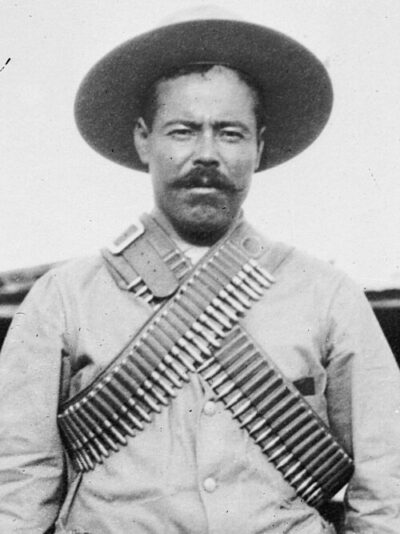
Pancho Villa
Pancho Villa was a Mexican revolutionary. Born June 5, 1878, in San Juan del Río del Centauro del Norte. Died July 20, 1923, in Hidalgo del Parral. Positions held include Governor of Chihuahua (1913–1914).
Facts
16 facts · 2 confirmed by two sources · 4 cited · 10 from one source
Where this comes from
Papalocal keeps its own record. It started from these sources; what each one said is kept here as it was copied, so a change on their side never changes this page by itself. Tap one to read its version.
What Wikidata says · copied November 16, 2026 · revision 2568064813
- Described as
- Mexican revolutionary (1878-1923)
- Other names
- Jose Doroteo Arango Arámbula, Francisco "Pancho" Villa, Francisco Villa, José Doroteo Arango Arámbula
- Born
- June 5, 1878 · 4 references
- Died
- July 20, 1923 · 3 references
- Born in
- San Juan del Río del Centauro del Norte
- Died in
- Hidalgo del Parral
- Cause of death
- gunshot wound
- Name at birth
- José Doroteo Arango Arámbula
- Citizen of
- Mexico
- Occupation
- politician; partisan; national hero · 1 reference; revolutionary · 1 reference
- Positions held
- Governor of Chihuahua (1913–1914)
- Spouse
- María Luz Corral
- Religion
- Catholicism · 1 reference
- Military branch
- cavalry
- Military rank
- general · 1 reference
- Wikipedias with a page
- 79
Wikidata item Q192278 (wikidata.org/wiki/Q192278), public domain (CC0). Copied November 16, 2026.
What Wikipedia says · copied November 16, 2026 · revision 1385307270
Francisco "Pancho" Villa (UK: PAN-choh VEE-ə, US: PAHN-choh VEE-(y)ə, Spanish: [ˈpantʃo ˈβiʎa]; born José Doroteo Arango Arámbula; 5 June 1878 – 20 July 1923) was a Mexican revolutionary, guerrilla leader, and politician. He was a key figure in the Mexican Revolution, a period of political and social upheaval that transformed Mexico's government. Operating primarily in northern Mexico, Villa commanded the revolutionary forces known as the Division of the North and became an influential military and political figure. A supporter of land reform, he briefly served as provisional governor of Chihuahua from 1913 to 1914.
Following the defeat of General Victoriano Huerta in the Mexican Revolution, divisions among revolutionary factions led to renewed civil war. Villa broke with Venustiano Carranza and allied with Emiliano Zapata, but was decisively defeated by Constitutionalist general Álvaro Obregón in 1915. The U.S. aided Carranza against Villa, including during the Second Battle of Agua Prieta. Following his military defeats and the loss of much of his army, Villa increasingly struggled to maintain his forces. Angered at U.S. support for Carranza, he raided the border town of Columbus, New Mexico in March 1916, prompting a U.S. expedition to Mexico. Despite superior military technology, the U.S. failed to capture him. When Carranza was ousted from power in 1920, Villa negotiated an amnesty with interim president Adolfo de la Huerta and was given a landed estate, on the condition he retire from politics. Villa was assassinated in 1923. Although his faction did not prevail in the Revolution, he was one of its most prominent figures.
Villa was imaged as an internationally known revolutionary hero, starring in Hollywood films and giving interviews to foreign journalists, most notably John Reed. At the height of his power and popularity in late 1914 and early 1915, the U.S. considered recognizing Villa as Mexico's legitimate president. In Mexico, Villa is generally regarded as a hero of the Revolution who stood up to the United States. Some American media outlets describe Villa as a villain and a murderer. After his death, he was excluded from the pantheon of revolutionary heroes until the Sonoran generals Obregón and Calles, whom he battled during the Revolution, were gone from the political stage. Villa's exclusion from the official narrative of the Revolution might have contributed to his continued posthumous popular acclaim. He was celebrated during the Revolution and long afterward by corridos, films about his life and novels by prominent writers. In 1976, his remains were reburied in the Monument to the Revolution in Mexico City in a huge public ceremony.
- Born, in its opening lines
- June 5, 1878
- Died, in its opening lines
- July 20, 1923
From the Wikipedia article “Pancho Villa” (en.wikipedia.org/wiki/Pancho_Villa), by its contributors, under CC BY-SA 4.0 (creativecommons.org/licenses/by-sa/4.0/). Copied November 16, 2026; not changed.
Confirmed Two sources agree. Cited One source, and it names where it got it. One source One source, without a reference of its own. Sources disagree The sources disagree. We show the best-supported value and keep theirs below.
