
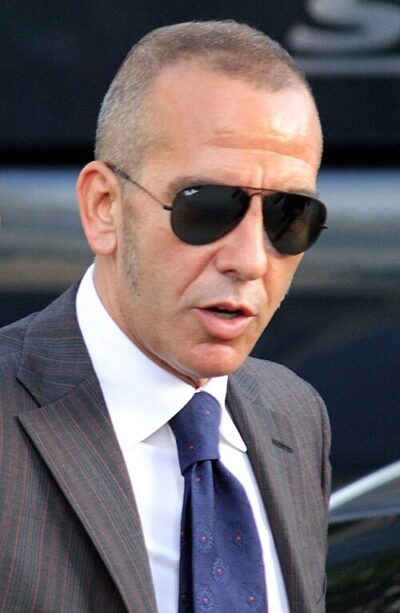
Paolo Di Canio
Paolo Di Canio is an Italian football player and manager. Born July 9, 1968, in Rome. Teams include Juventus FC (1990–1993), SS Lazio (2 times) (1985–2006) and Ternana Calcio (1986–1987).
Facts
20 facts · 1 confirmed by two sources · 3 cited · 16 from one source
Where this comes from
Papalocal keeps its own record. It started from these sources; what each one said is kept here as it was copied, so a change on their side never changes this page by itself. Tap one to read its version.
What Wikidata says · copied November 16, 2026 · revision 2569076033
- Described as
- Italian football player and manager
- Born
- July 9, 1968 · 1 reference
- Born in
- Rome
- Citizen of
- Italy
- Occupation
- association football player (–2008) · 1 reference; association football coach · 1 reference; television presenter; beach soccer player
- Teams
- Juventus FC (1990–1993); SS Lazio (2 times) (1985–2006); Ternana Calcio (1986–1987); Sheffield Wednesday F.C. (1997–1999); West Ham United F.C. (1999–2003); SSC Napoli (1993–1994); Celtic F.C. (1996–1997); Charlton Athletic F.C. (2003–2004); AC Milan (1994–1996); Atletico Roma F.C. (2006–2008); Italy national under-21 football team (1988–1990)
- Sport
- association football · 1 reference
- Height
- 1.78 m (5 ft 10 in)
- Wikipedias with a page
- 44
Wikidata item Q44655 (wikidata.org/wiki/Q44655), public domain (CC0). Copied November 16, 2026.
What Wikipedia says · copied November 16, 2026 · revision 1383026372
Paolo Di Canio (born 9 July 1968) is an Italian former professional footballer and manager. During his playing career he made over 500 league appearances and scored over one hundred goals as a forward. He primarily played as a deep-lying forward, but he could also play as an attacking midfielder, or as a winger. Di Canio was regarded as a technically skilled but temperamental player.
Di Canio began his career in the Italian Serie A, playing for Lazio, Juventus, Napoli and Milan, before a brief spell with the Scottish club Celtic. He subsequently spent seven years in the English Premier League with Sheffield Wednesday, West Ham United and Charlton Athletic. He returned to Italy in 2004, playing for Lazio and Cisco Roma before retiring in 2008. He played for the Italian under-21s, making nine appearances and scoring twice, and was a member of the squad that finished in third place at the 1990 UEFA European Under-21 Championship under manager Cesare Maldini, but was never capped for the senior team.
Among the individual awards he received as a player, Di Canio was named SPFA Players' Player of the Year in 1997 and West Ham's player of the season in 2000. However, his career was at times characterised by controversy: he received an eleven-match ban in 1998 for pushing a referee and attracted negative publicity over his allegiance to fascism.
In 2011, Di Canio entered football management in England with Swindon Town, guiding them in his first full season as manager to promotion to League One. He was appointed as the Sunderland manager at the end of March 2013 but was sacked on 22 September after Sunderland had won only three of thirteen games under his managership.
- Born, in its opening lines
- July 9, 1968
From the Wikipedia article “Paolo Di Canio” (en.wikipedia.org/wiki/Paolo_Di_Canio), by its contributors, under CC BY-SA 4.0 (creativecommons.org/licenses/by-sa/4.0/). Copied November 16, 2026; not changed.
Confirmed Two sources agree. Cited One source, and it names where it got it. One source One source, without a reference of its own. Sources disagree The sources disagree. We show the best-supported value and keep theirs below.
