
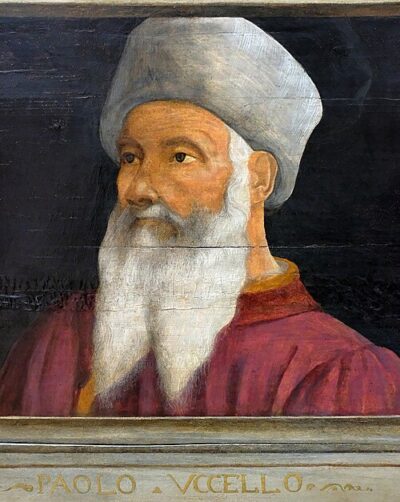
Paolo Uccello
Paolo Uccello was an Italian painter. Born June 15, 1397, in Pratovecchio. Died December 10, 1475, in Florence. Known for The Battle of San Romano, Funerary Monument to Sir John Hawkwood and Saint George and the Dragon.
Facts
19 facts · 2 confirmed by two sources · 5 cited · 12 from one source
Where this comes from
Papalocal keeps its own record. It started from these sources; what each one said is kept here as it was copied, so a change on their side never changes this page by itself. Tap one to read its version.
What Wikidata says · copied November 16, 2026 · revision 2565110571
- Described as
- Italian painter (1397-1475)
- Other names
- Paolo di Dono, Paolo Di Dono Uccello, Uccello, Paolo di Dono Uccello, Paolo Di Dono, paolo ucello, Paul Uccello
- Born
- June 15, 1397 · 2 references
- Died
- December 10, 1475 · 4 references
- Born in
- Pratovecchio · 3 references
- Died in
- Florence · 4 references
- Occupation
- painter · 3 references; mosaicist · 1 reference
- Genre
- history painting · 2 references
- Known for
- The Battle of San Romano; Funerary Monument to Sir John Hawkwood; Saint George and the Dragon; The Hunt in the Forest; Madonna Martello; Beccuto Madonna; Creation of Adam, animals, and Eve, and the Original Sin; Crucifixion of Christ; The Annunciation; Portrait of a Young Man
- Field
- painting · 1 reference
- Children
- Antonia di Paolo di Dono
- Wikipedias with a page
- 59
Wikidata item Q192488 (wikidata.org/wiki/Q192488), public domain (CC0). Copied November 16, 2026.
What Wikipedia says · copied November 16, 2026 · revision 1369471709
Paolo Uccello ( oo-CHEL-oh, Italian: [ˈpaːolo utˈtʃɛllo]; 1397 – 10 December 1475), born Paolo di Dono, was an Italian Renaissance painter and mathematician from Florence who was notable for his pioneering work on visual perspective in art. In his book Lives of the Most Excellent Painters, Sculptors, and Architects, Giorgio Vasari wrote that Uccello was obsessed by his interest in perspective and would stay up all night in his study trying to grasp the exact vanishing point. Uccello used perspective to create a feeling of depth in his paintings. His best known works are the three paintings representing the battle of San Romano, which were wrongly entitled the Battle of Sant'Egidio of 1416 for a long period of time.
Paolo worked in the Late Gothic tradition, emphasizing colour and pageantry rather than the classical realism that other artists were pioneering. His style is best described as idiosyncratic, and he left no school of followers. He has had some influence on twentieth-century art and literary criticism (e.g., in the Vies imaginaires by Marcel Schwob, Uccello le poil by Antonin Artaud and O Mundo Como Ideia by Bruno Tolentino).
- Born, in its opening lines
- 1397
- Died, in its opening lines
- December 10, 1475
From the Wikipedia article “Paolo Uccello” (en.wikipedia.org/wiki/Paolo_Uccello), by its contributors, under CC BY-SA 4.0 (creativecommons.org/licenses/by-sa/4.0/). Copied November 16, 2026; not changed.
Confirmed Two sources agree. Cited One source, and it names where it got it. One source One source, without a reference of its own. Sources disagree The sources disagree. We show the best-supported value and keep theirs below.
