
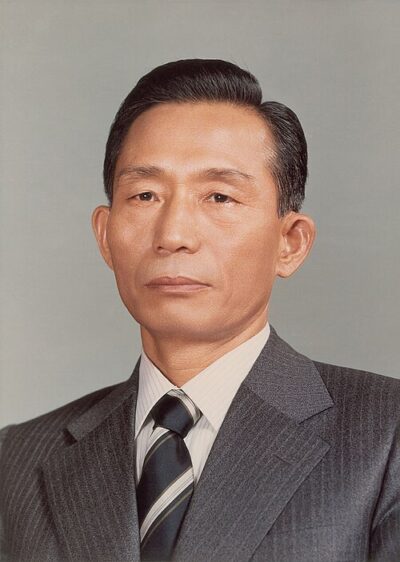
Park Chung-hee
Park Chung-hee was the 3rd President of the Republic of Korea. Born November 14, 1917, in Gumi. Died October 26, 1979, in Jongno District. Positions held include President of South Korea (1962–1979). Educated at Imperial Japanese Army Academy and Manchukuo Army Military Academy. Awards include Order of the Rajamitrabhorn, Order of the Crown of the Realm and Grand Cross of the Order of the Aztec Eagle.
Facts
47 facts · 2 confirmed by two sources · 3 cited · 42 from one source
Where this comes from
Papalocal keeps its own record. It started from these sources; what each one said is kept here as it was copied, so a change on their side never changes this page by itself. Tap one to read its version.
What Wikidata says · copied November 16, 2026 · revision 2565534114
- Described as
- 3rd President of the Republic of Korea
- Other names
- Bak Jeonghui, Pak Chŏnghŭi, Masao Takagi
- Born
- November 14, 1917 · 1 reference
- Died
- October 26, 1979 · 7 references
- Born in
- Gumi · 1 reference
- Died in
- Jongno District
- Buried in
- Seoul National Cemetery
- Cause of death
- gunshot wound
- Citizen of
- South Korea
- Occupation
- politician · 1 reference; army officer
- Positions held
- President of South Korea (1962–1979)
- Political party
- Democratic-Republican Party
- Education
- Imperial Japanese Army Academy; Manchukuo Army Military Academy; Korea Military Academy · 1 reference
- Awards
- Order of the Rajamitrabhorn; Order of the Crown of the Realm; Grand Cross of the Order of the Aztec Eagle; Order of Propitious Clouds · 1 reference; Grand Star of the Decoration for Services to the Republic of Austria; Order of Merit for National Foundation; Knight Grand Cross in the Order of the Netherlands Lion; Grand Order of Mugunghwa · 1 reference; Order of Diplomatic Service Merit · 1 reference; Order of Civil Merit · 1 reference; Order of Merit of the Federal Republic of Germany · 1 reference; Order of Merit of the Italian Republic · 1 reference; Order of the Aztec Eagle · 1 reference; Order of the Netherlands Lion · 1 reference; Order of Sikatuna · 1 reference
- Spouse
- Kim Ho Nam (1936–1950); Yuk Young-soo (1950–1974)
- Children
- Park Geun-ryeong; Park Ji-man; Park Geun-hye · 1 reference; Park Jae-ok
- Father
- Park Seong-bin
- Mother
- Baek Nam-ui
- Siblings
- Park Jae-hee; Park Sang-hee; Park Dong-hee; Park Han-saeng; Park Mu-hee; Park Gwi-hee · 1 reference
- Religion
- Buddhism
- Military branch
- Manchukuo Imperial Army (–1945); Republic of Korea Army
- Military rank
- two-star rank
- Wikipedias with a page
- 98
Wikidata item Q14356 (wikidata.org/wiki/Q14356), public domain (CC0). Copied November 16, 2026.
What Wikipedia says · copied November 16, 2026 · revision 1385228827
Park Chung Hee (Korean: 박정희, pronounced [pak̚ tɕ͈ʌ̹ŋʝi] ; 14 November 1917 – 26 October 1979) was a South Korean politician and army officer who seized power in the May 16 coup of 1961, and served as the third President of South Korea from 1962 until his assassination in 1979. His regime oversaw a period of intense economic growth and transformation, making Park one of the most consequential leaders in Korean history, although his legacy as a military dictator remains a bitter subject.
Before his presidency, Park was the second-highest-ranking officer in the South Korean army. His coup brought an end to the interim Second Republic of Korea. After serving for two years as chairman of the military junta, he was elected president in 1963, ushering in the Third Republic. A firm anti-communist, he continued to maintain close ties with the United States, which had maintained a large Army garrison in the country since the end of the Korean War. He supported American military involvement in Southeast Asia, and sent South Korean troops to fight in Vietnam soon after seizing power. Park began a series of economic reforms that eventually led to rapid and unprecedented economic growth and industrialization, a phenomenon that is now known as the Miracle on the Han River. This made South Korea one of the fastest growing economies of the 1960s and 1970s, albeit with costs to labor rights. This era also saw the formation of chaebols: family companies supported by the state similar to the Japanese zaibatsu. Examples of significant chaebols include Hyundai, LG, and Samsung.
Although popular during the 1960s, Park's popularity started to plateau by the 1970s, with closer than expected victories during the 1971 presidential election and the subsequent legislative elections. In 1972, Park declared martial law after carrying out a self-coup. He then introduced the highly authoritarian Yushin Constitution, ushering in the Fourth Republic. Now ruling as a dictator, he constantly repressed political opposition and dissent and completely controlled the military. He also had much control over the media and expressions of art. In 1979, Park was assassinated by his close friend Kim Jae-gyu, director of the KCIA, following the Busan–Masan Uprising. Whether the assassination was spontaneous or premeditated remains unclear to this day. Economic growth continued in spite of the 1979 coup d'état and considerable political turmoil in the wake of his assassination. He was soon afterwards succeeded by Choi Kyu-hah, who ruled for only a year before being deposed by career army officer Chun Doo-hwan. The country eventually democratized with the June Democratic Struggle in 1987.
Park remains a controversial figure in modern South Korean political discourse and among the South Korean populace in general, making a detached evaluation of his tenure difficult. While some credit him for sustaining economic growth that reshaped and modernized South Korea, others criticize his authoritarian governance (especially after 1971) as well as for prioritizing economic growth and social order at the expense of civil liberties and human rights. A Gallup Korea poll in October 2021 showed Park, Kim Dae-jung (an old opponent of Park whom he tried to have executed), and Roh Moo-hyun as the most highly rated presidents of South Korean history in terms of leaving a positive legacy, especially among South Korean conservatives and the elderly. Park's daughter Park Geun Hye later served as the 11th president of South Korea from 2013 until she was impeached and convicted of various corruption charges in 2017.
- Born, in its opening lines
- November 14, 1917
- Died, in its opening lines
- October 26, 1979
From the Wikipedia article “Park Chung Hee” (en.wikipedia.org/wiki/Park_Chung_Hee), by its contributors, under CC BY-SA 4.0 (creativecommons.org/licenses/by-sa/4.0/). Copied November 16, 2026; not changed.
Confirmed Two sources agree. Cited One source, and it names where it got it. One source One source, without a reference of its own. Sources disagree The sources disagree. We show the best-supported value and keep theirs below.
