
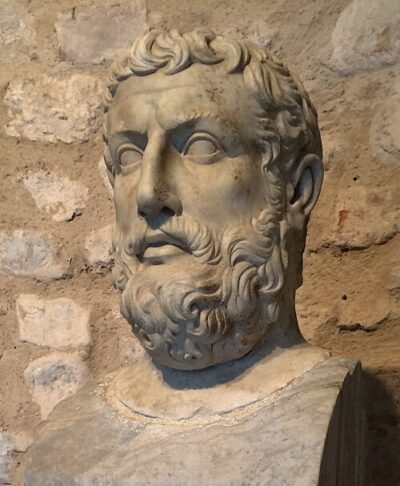
Parmenides
Parmenides was a late 6th/early 5th century BC Greek pre-Socratic philosopher. Born 515 BC, in Velia. Died 470 BC.
Facts
10 facts · 0 confirmed by two sources · 6 cited · 4 from one source
Where this comes from
Papalocal keeps its own record. It started from these sources; what each one said is kept here as it was copied, so a change on their side never changes this page by itself. Tap one to read its version.
What Wikidata says · copied November 16, 2026 · revision 2568298885
- Described as
- late 6th/early 5th century BC Greek pre-Socratic philosopher
- Other names
- Parmenides of Elea
- Born
- 515 BC · 2 references
- Died
- 470 BC · 1 reference
- Born in
- Velia · 2 references
- Occupation
- philosopher · 2 references; writer · 1 reference; poet; legislator
- Field
- philosophy; ancient Greek philosophy · 1 reference; metaphysics
- Wikipedias with a page
- 113
Wikidata item Q125551 (wikidata.org/wiki/Q125551), public domain (CC0). Copied November 16, 2026.
What Wikipedia says · copied November 16, 2026 · revision 1378881406
Parmenides of Elea (; Ancient Greek: Παρμενίδης ὁ Ἐλεάτης; fl. late sixth or early fifth century BC) was a pre-Socratic Greek philosopher from Elea in Magna Graecia (Southern Italy).
Parmenides was born in the Greek colony of Elea to a wealthy and illustrious family. The exact date of his birth is not known with certainty; on the one hand, according to the doxographer Diogenes Laërtius, Parmenides flourished in the period immediately preceding 500 BC, which would place his year of birth around 540 BC; on the other hand, in the dialogue Parmenides Plato portrays him as visiting Athens at the age of 65, when Socrates was a young man, c. 450 BC, which, if true, suggests a potential year of birth of c. 515 BC. Parmenides is thought to have been in his prime (or "floruit") around 475 BC.
The single known work by Parmenides is a philosophical poem in dactylic hexameter verse whose original title is unknown but which is often referred to as On Nature. Only fragments of it survive, but the integrity of the poem is remarkably higher than what has come down to us from the works of almost all other pre-Socratic philosophers, and therefore classicists can reconstruct the philosophical doctrines with greater precision. In his poem, Parmenides prescribes two views of reality. The first, the way of "Aletheia" or truth, describes how all reality is one, change is impossible, and existence is timeless and uniform. The second view, the way of "Doxa" or opinion, describes the world of appearances, in which one's sensory faculties lead to conceptions that are false and deceitful.
Parmenides has been considered the founder of ontology and has, through his influence on Plato, influenced the whole history of Western philosophy. He is also considered to be the founder of the Eleatic school of philosophy, which also included Zeno of Elea and Melissus of Samos. Zeno's paradoxes of motion were developed to defend Parmenides's views. In contemporary philosophy, Parmenides's work has remained relevant in debates about the philosophy of time.
From the Wikipedia article “Parmenides” (en.wikipedia.org/wiki/Parmenides), by its contributors, under CC BY-SA 4.0 (creativecommons.org/licenses/by-sa/4.0/). Copied November 16, 2026; not changed.
Confirmed Two sources agree. Cited One source, and it names where it got it. One source One source, without a reference of its own. Sources disagree The sources disagree. We show the best-supported value and keep theirs below.
