
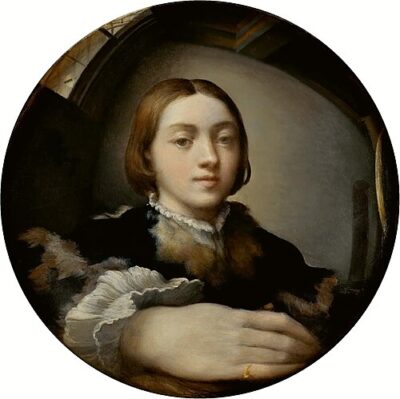
Parmigianino
Parmigianino was an Italian Mannerist painter and printmaker. Born January 11, 1503, in Parma. Died August 24, 1540, in Casalmaggiore. Known for The Circumcision, Self-portrait in a Convex Mirror and Portrait of a Man in a Red Beret.
Facts
21 facts · 2 confirmed by two sources · 12 cited · 7 from one source
Where this comes from
Papalocal keeps its own record. It started from these sources; what each one said is kept here as it was copied, so a change on their side never changes this page by itself. Tap one to read its version.
What Wikidata says · copied November 16, 2026 · revision 2569305357
- Described as
- Italian Mannerist painter and printmaker (1503–1540)
- Other names
- Girolamo Francesco Maria Mazzola, Francesco Mazzola, Parmigiano, Il Parmigianino, Francesco Mazzuoli, Francesco Massola, Mazzuoli Parmigiano, Parmegianino, Francesco Mazzuola, Francesco Mazzoli, Parmeggianino, François Mazzuoli
- Born
- January 11, 1503 · 1 reference
- Died
- August 24, 1540 · 1 reference
- Born in
- Parma · 2 references
- Died in
- Casalmaggiore · 1 reference
- Occupation
- painter · 2 references; graphic artist · 1 reference; etcher · 2 references; draftsperson · 1 reference; printmaker · 1 reference; architectural drafter · 1 reference; visual artist · 1 reference; architect · 1 reference
- Genre
- history painting · 1 reference; portrait · 1 reference
- Known for
- The Circumcision; Self-portrait in a Convex Mirror; Portrait of a Man in a Red Beret; Madonna with the Long Neck; Mystic Marriage of Saint Catherine · 1 reference; Nativity · 1 reference
- Field
- painting · 1 reference
- Wikipedias with a page
- 49
Wikidata item Q9348 (wikidata.org/wiki/Q9348), public domain (CC0). Copied November 16, 2026.
What Wikipedia says · copied November 16, 2026 · revision 1382637575
Girolamo Francesco Maria Mazzola (11 January 1503 – 24 August 1540), also known as Francesco Mazzola or, more commonly, as Parmigianino (UK: , US: , Italian: [parmidʒaˈniːno]; "the little one from Parma"), was an Italian Mannerist painter and printmaker active in Florence, Rome, Bologna, and his native city of Parma. His work is characterized by a "refined sensuality" and often elongation of forms and includes Vision of Saint Jerome (1527) and the iconic if somewhat anomalous Madonna with the Long Neck (1534), and he remains the best-known artist of the first generation whose whole career falls into the Mannerist period.
His prodigious and individual talent has always been recognised, but his career was disrupted by war, especially the Sack of Rome in 1527, three years after he moved there, and then ended by his death at 37. He produced outstanding drawings and was one of the first Italian painters to experiment with printmaking himself. While his portable works have always been keenly collected and are now in major museums in Italy and around the world, his two large projects in fresco are in a church in Parma and a palace in a small town nearby. This, in conjunction with their lack of large main subjects, has resulted in their being less well known than other works by similar artists. He painted a number of important portraits, leading a trend in Italy towards the three-quarters or full-length figure, previously mostly reserved for royalty.
- Born, in its opening lines
- January 11, 1503
- Died, in its opening lines
- August 24, 1540
From the Wikipedia article “Parmigianino” (en.wikipedia.org/wiki/Parmigianino), by its contributors, under CC BY-SA 4.0 (creativecommons.org/licenses/by-sa/4.0/). Copied November 16, 2026; not changed.
Confirmed Two sources agree. Cited One source, and it names where it got it. One source One source, without a reference of its own. Sources disagree The sources disagree. We show the best-supported value and keep theirs below.
