
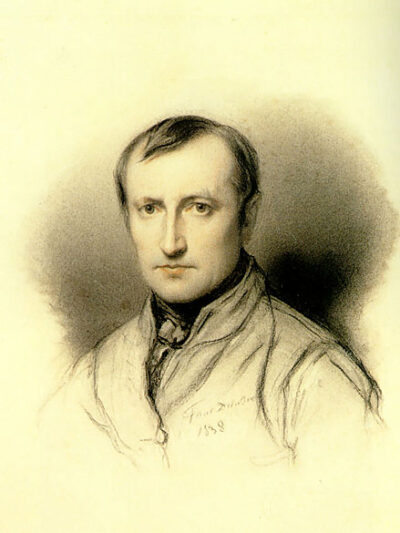
Paul Delaroche
Paul Delaroche was a French painter. Born July 17, 1797, in Paris. Died November 4, 1856, in Paris. Known for The Execution of Lady Jane Grey, Bonaparte Crossing the Alps and Charles I Insulted by Cromwell's Soldiers. Educated at Beaux-Arts de Paris. Awards include Pour le Mérite for Sciences and Arts order and Officer of the Legion of Honour.
Facts
27 facts · 2 confirmed by two sources · 8 cited · 17 from one source
Where this comes from
Papalocal keeps its own record. It started from these sources; what each one said is kept here as it was copied, so a change on their side never changes this page by itself. Tap one to read its version.
What Wikidata says · copied November 16, 2026 · revision 2569898864
- Described as
- French painter (1797-1856)
- Other names
- Hippolyte Paul Delaroche, Hippolyte Delaroche, Paul Hippolyte Delaroche, Paul de Laroche, Delaroche, P. De la Roche, P. Delaroche, Hippolyte-Paul Delaroche, Paul De la Roche
- Born
- July 17, 1797 · 15 references
- Died
- November 4, 1856 · 12 references
- Born in
- Paris · 2 references
- Died in
- Paris · 2 references
- Buried in
- Cimetière de Montmartre - Division 5 · 1 reference
- Name at birth
- Paul Hippolyte Delaroche
- Citizen of
- France · 1 reference
- Occupation
- painter · 2 references; photographer; illustrator · 1 reference; sculptor · 1 reference; draftsperson · 1 reference
- Worked for
- Beaux-Arts de Paris
- Education
- Beaux-Arts de Paris
- Member of
- Royal Netherlands Academy of Arts and Sciences · 1 reference; Académie des beaux-arts; Société de l'histoire de France (1835–); Accademia delle Arti del Disegno
- Genre
- history painting
- Known for
- The Execution of Lady Jane Grey; Bonaparte Crossing the Alps; Charles I Insulted by Cromwell's Soldiers; The Assassination of the Duke of Guise
- Awards
- Pour le Mérite for Sciences and Arts order; Officer of the Legion of Honour (1834)
- Spouse
- Louise Vernet
- Siblings
- Jules Delaroche
- Wikipedias with a page
- 41
Wikidata item Q322582 (wikidata.org/wiki/Q322582), public domain (CC0). Copied November 16, 2026.
What Wikipedia says · copied November 16, 2026 · revision 1374122000
Hippolyte-Paul Delaroche (French pronunciation: [ipɔlit pɔl dəlaʁɔʃ]; 17 July 1797 – 4 November 1856) was a French painter known for his depiction of scenes from English and French history. The emotions emphasised in Delaroche's paintings appeal to Romanticism while the detail of his work along with the deglorified portrayal of historic figures follow the trends of Academicism and Neoclassicism. Delaroche aimed to depict his subjects and history with pragmatic realism. He did not consider popular ideals and norms in his creations, but rather painted all his subjects in the same light whether they were historical figures like Marie-Antoinette, figures of Christianity, or people of his time like Napoleon Bonaparte. Delaroche was a leading pupil of Antoine-Jean Gros and later mentored a number of notable artists such as Thomas Couture, Jean-Léon Gérôme, and Jean-François Millet.
Delaroche was born into a generation that saw the stylistic conflicts between Romanticism and Davidian Classicism. Davidian Classicism was widely accepted and enjoyed by society so as a developing artist at the time of the introduction of Romanticism in Paris, Delaroche found his place between the two movements. Subjects from Delaroche's medieval and sixteenth and seventeenth-century history paintings appealed to Romantics while the accuracy of information along with the highly finished surfaces of his paintings appealed to Academics and Neoclassicism. Delaroche's works completed in the early 1830s most reflected the position he took between the two movements and were admired by contemporary artists of the time—the Execution of Lady Jane Grey (1833; National Gallery, London) was the most acclaimed of Delaroche's paintings in its day. Later in the 1830s, Delaroche exhibited the first of his major religious works. His change of subject and "the painting's austere manner" were ill-received by critics and after 1837, he stopped exhibiting his work altogether. At the time of his death in 1856, he was painting a series of four scenes from the Life of the Virgin. Only one work from this series was completed: the Virgin Contemplating the Crown of Thorns.
- Born, in its opening lines
- July 17, 1797
- Died, in its opening lines
- November 4, 1856
From the Wikipedia article “Paul Delaroche” (en.wikipedia.org/wiki/Paul_Delaroche), by its contributors, under CC BY-SA 4.0 (creativecommons.org/licenses/by-sa/4.0/). Copied November 16, 2026; not changed.
Confirmed Two sources agree. Cited One source, and it names where it got it. One source One source, without a reference of its own. Sources disagree The sources disagree. We show the best-supported value and keep theirs below.
