
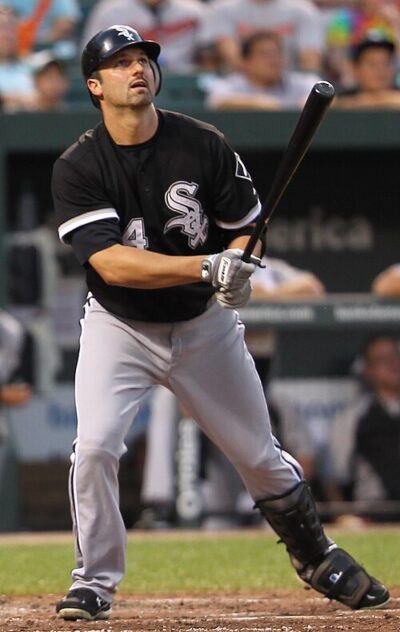
Paul Konerko
Paul Konerko is an American professional baseball player, first baseman. Born March 5, 1976, in Providence. Teams include Chicago White Sox (1999–2014), Los Angeles Dodgers and Cincinnati Reds. Educated at Chaparral High School.
Facts
11 facts · 1 confirmed by two sources · 2 cited · 8 from one source
Where this comes from
Papalocal keeps its own record. It started from these sources; what each one said is kept here as it was copied, so a change on their side never changes this page by itself. Tap one to read its version.
What Wikidata says · copied November 18, 2026 · revision 2529572819
- Described as
- American professional baseball player, first baseman
- Other names
- Konerko, Paulie Konerko, Paul Henry Konerko
- Born
- March 5, 1976
- Born in
- Providence
- Citizen of
- United States
- Occupation
- baseball player · 1 reference
- Education
- Chaparral High School · 1 reference
- Teams
- Chicago White Sox (1999–2014); Los Angeles Dodgers; Cincinnati Reds; Yakima Bears
- Sport
- baseball · 1 reference
- Height
- 1.90 m (6 ft 3 in)
- Wikipedias with a page
- 14
Wikidata item Q685623 (wikidata.org/wiki/Q685623), public domain (CC0). Copied November 18, 2026.
What Wikipedia says · copied November 18, 2026 · revision 1380063178
Paul Henry Konerko ( kə-NAIR-koh; born March 5, 1976) is an American former professional baseball player. He played in Major League Baseball (MLB) as a first baseman from 1997 to 2014, most prominently as a member of the Chicago White Sox, where he was a six-time American League All-Star and team captain for the 2005 World Series winning team. Konerko began his career with the Los Angeles Dodgers and the Cincinnati Reds. In 2014, Konerko was named the recipient of the prestigious Roberto Clemente Award.
- Born, in its opening lines
- March 5, 1976
From the Wikipedia article “Paul Konerko” (en.wikipedia.org/wiki/Paul_Konerko), by its contributors, under CC BY-SA 4.0 (creativecommons.org/licenses/by-sa/4.0/). Copied November 18, 2026; not changed.
Confirmed Two sources agree. Cited One source, and it names where it got it. One source One source, without a reference of its own. Sources disagree The sources disagree. We show the best-supported value and keep theirs below.
