
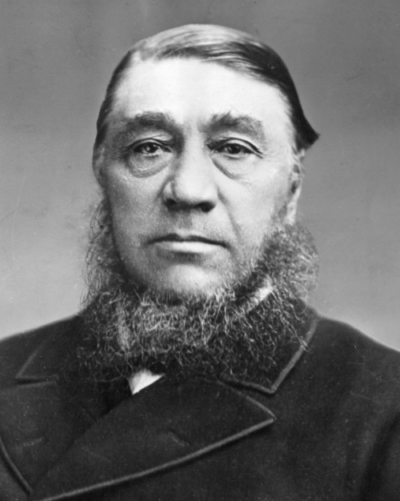
Paul Kruger
Paul Kruger was a South African politician and President of the South African Republic. Born October 10, 1825, in Cape Colony. Died July 14, 1904, in Clarens. Positions held include President of the South African Republic (1883–1900).
Facts
12 facts · 2 confirmed by two sources · 3 cited · 7 from one source
Where this comes from
Papalocal keeps its own record. It started from these sources; what each one said is kept here as it was copied, so a change on their side never changes this page by itself. Tap one to read its version.
What Wikidata says · copied November 16, 2026 · revision 2563066761
- Described as
- South African politician and President of the South African Republic (1825–1904)
- Other names
- Stephanus Johannes Paulus Kruger, S. J. Paul Krüger
- Born
- October 10, 1825 · 10 references
- Died
- July 14, 1904 · 10 references
- Born in
- Cape Colony
- Died in
- Clarens · 1 reference
- Buried in
- Heroes' Acre
- Cause of death
- pneumonia
- Citizen of
- South African Republic
- Occupation
- politician · 1 reference
- Positions held
- President of the South African Republic (1883–1900)
- Spouse
- Gezina Suzanna Frederika du Plessis · 1 reference; Maria du Plessis
- Military rank
- general
- Wikipedias with a page
- 57
Wikidata item Q244407 (wikidata.org/wiki/Q244407), public domain (CC0). Copied November 16, 2026.
What Wikipedia says · copied November 16, 2026 · revision 1378807325
Stephanus Johannes Paulus Kruger (Afrikaans pronunciation: [ˈkry.(j)ər]; 10 October 1825 – 14 July 1904) was a South African politician. He was one of the dominant political and military figures in 19th-century South Africa, and State President of the South African Republic (or Transvaal) from 1883 to 1900. Nicknamed "Oom Paul" (Afrikaans for 'Uncle Paul'), he came to international prominence as the face of the Boer cause—that of the Transvaal and its neighbour the Orange Free State—against Britain during the Second Boer War of 1899–1902. He has been called a personification of Afrikanerdom and admirers venerate him as a tragic folk hero.
Born near the eastern edge of the Cape Colony, Kruger took part in the Great Trek as a child during the late 1830s. He had almost no education apart from the Bible. A protégé of the Voortrekker leader Andries Pretorius, he witnessed the signing of the Sand River Convention with Britain in 1852 and over the next decade played a prominent role in the forging of the South African Republic, leading its commandos and resolving disputes between the rival Boer leaders and factions. In 1863 he was elected Commandant-General, a post he held for a decade; he resigned soon after the election of President Thomas François Burgers.
Kruger was appointed vice president in March 1877, shortly before the South African Republic was annexed by Britain as the Transvaal. Over the next three years he headed two deputations to London to try to have this overturned. He became the leading figure in the movement to restore the South African Republic's independence, culminating in the Boers' victory in the First Boer War of 1880–1881. Kruger served until 1883 as a member of an executive triumvirate, then was elected president. In 1884 he headed a third deputation that brokered the London Convention, under which Britain recognised the South African Republic as a completely independent state.
Following the influx of thousands of predominantly British settlers with the Witwatersrand Gold Rush of 1886, "uitlanders" (foreigners) provided almost all of the South African Republic's tax revenues but lacked civic representation; Boer burghers retained control of the government. The uitlander problem and the associated tensions with Britain dominated Kruger's attention for the rest of his presidency, to which he was re-elected in 1888, 1893 and 1898, and led to the Jameson Raid of 1895–1896 and ultimately the Second Boer War. Kruger left for Europe as the war turned against the Boers in 1900 and spent the rest of his life in exile, refusing to return home following the British victory. After he died in Switzerland at the age of 78 in 1904, his body was returned to South Africa for a state funeral, and buried in the Heroes' Acre in Pretoria.
- Born, in its opening lines
- October 10, 1825
- Died, in its opening lines
- July 14, 1904
From the Wikipedia article “Paul Kruger” (en.wikipedia.org/wiki/Paul_Kruger), by its contributors, under CC BY-SA 4.0 (creativecommons.org/licenses/by-sa/4.0/). Copied November 16, 2026; not changed.
Confirmed Two sources agree. Cited One source, and it names where it got it. One source One source, without a reference of its own. Sources disagree The sources disagree. We show the best-supported value and keep theirs below.
