
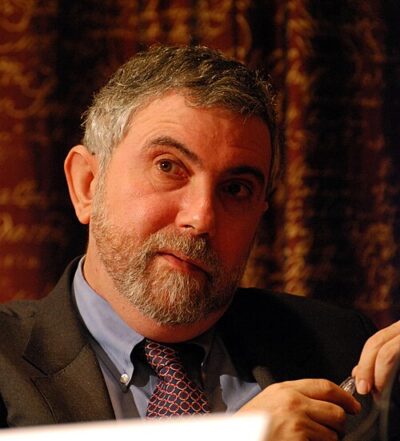
Paul Krugman
Paul Krugman is an American economist. Born February 28, 1953, in Albany. Educated at John F. Kennedy High School and Grace Hopper College. Awards include Adam Smith Award, Princess of Asturias Award for Social Sciences and Four Freedoms Award – Freedom of Speech.
Facts
45 facts · 1 confirmed by two sources · 14 cited · 30 from one source
Where this comes from
Papalocal keeps its own record. It started from these sources; what each one said is kept here as it was copied, so a change on their side never changes this page by itself. Tap one to read its version.
What Wikidata says · copied November 13, 2026 · revision 2563065307
- Described as
- American economist (born 1953)
- Other names
- Paul Robin Krugman, Paul R Krugman
- Born
- February 28, 1953 · 5 references
- Born in
- Albany · 1 reference
- Citizen of
- United States
- Occupation
- columnist · 1 reference; economist · 2 references; essayist; blogger; professor; pundit; journalist · 1 reference; writer
- Worked for
- Banco de Portugal (1976); Yale University (1977–); Massachusetts Institute of Technology (2 times) (1979–); National Bureau of Economic Research (1979–); Council of Economic Advisers (1982–1983); Stanford University; London School of Economics and Political Science; Princeton University (2000–2015)
- Education
- John F. Kennedy High School · 1 reference; Grace Hopper College (1970–1974); Massachusetts Institute of Technology (1974–1977)
- Member of
- American Academy of Arts and Sciences; Group of Thirty · 1 reference; Econometric Society (1986–) · 1 reference
- Awards
- Adam Smith Award (1995) · 1 reference; Princess of Asturias Award for Social Sciences (2004) · 1 reference; Four Freedoms Award – Freedom of Speech (2013); John Bates Clark Medal (1991) · 1 reference; Prize in Economic Sciences in Memory of Alfred Nobel (2008) · 1 reference; H. C. Recktenwald Prize in Economics (2000) · 1 reference; James Joyce Awards (2014) · 1 reference; Global Economy Prize (2010) · 2 references; Gerald Loeb Award winners for Columns, Commentary, and Editorials (2011); Fellow of the Econometric Society (1986) · 2 references; Fellow of the American Academy of Arts and Sciences; Honorary doctor of the Free University of Berlin; honorary doctor of the University of Lisbon; honorary doctor from the NOVA University Lisbon; Honorary doctor of the University of Oxford
- Field
- international economics; macroeconomics; international economic relations · 1 reference
- Spouse
- Robin Wells
- Website
- https://web.mit.edu/krugman/www/
- Wikipedias with a page
- 87
Wikidata item Q131112 (wikidata.org/wiki/Q131112), public domain (CC0). Copied November 13, 2026.
What Wikipedia says · copied November 13, 2026 · revision 1385412899
Paul Robin Krugman ( KRUUG-mən; born February 28, 1953) is an American economist who is the Distinguished Professor of Economics at the Graduate Center of the City University of New York. He was a columnist for The New York Times from 2000 to 2024. In 2008, Krugman was the sole winner of the Nobel Memorial Prize in Economic Sciences for his contributions to new trade theory and new economic geography. The Prize Committee cited Krugman's work explaining the patterns of international trade and the geographic distribution of economic activity, by examining the effects of economies of scale and of consumer preferences for diverse goods and services.
Krugman was previously a professor of economics at MIT, and later, at Princeton University from where he retired in June 2015, holding the title of professor emeritus there. He also holds the title of Centennial Professor at the London School of Economics. Krugman was President of the Eastern Economic Association in 2010, and is among the most influential economists in the world. He is known in academia for his work on international economics (including trade theory and international finance), economic geography, liquidity traps, and currency crises.
Krugman is the author or editor of 27 books, including scholarly works, textbooks, and books for a more general audience, and has published more than 200 scholarly articles in professional journals and edited volumes. He has also written several hundred columns on economic and political issues for The New York Times, Fortune and Slate. A 2011 survey of economics professors named him their favorite living economist under the age of 60. According to the Open Syllabus Project, Krugman is the second most frequently cited author on college syllabi for economics courses. As a commentator, Krugman has written on a wide range of economic issues including income distribution, taxation, macroeconomics, and international economics. Krugman considers himself a modern liberal, referring to his books, his blog on The New York Times, and his 2007 book The Conscience of a Liberal. His popular commentary has attracted widespread praise and criticism.
On December 6, 2024, New York Times opinion editor Kathleen Kingsbury announced that Krugman was retiring as a Times columnist; His final column, titled 'Finding Hope in an Age of Resentment,' was published on December 9, 2024. Afterwards, Krugman began publishing a daily newsletter on Substack. The newsletter, titled "Paul Krugman," publishes most content for free while offering a longer weekly tutorial post to paid subscribers. Krugman's wife, economist Robin Wells, serves as his editor for the newsletter. By mid-2025, the newsletter was reaching 350,000-450,000 readers per post. Krugman wrote there that he left the Times because his editors began to discourage him from writing columns that might "get some people (particularly on the right) riled up."
- Born, in its opening lines
- February 28, 1953
From the Wikipedia article “Paul Krugman” (en.wikipedia.org/wiki/Paul_Krugman), by its contributors, under CC BY-SA 4.0 (creativecommons.org/licenses/by-sa/4.0/). Copied November 13, 2026; not changed.
Confirmed Two sources agree. Cited One source, and it names where it got it. One source One source, without a reference of its own. Sources disagree The sources disagree. We show the best-supported value and keep theirs below.
