
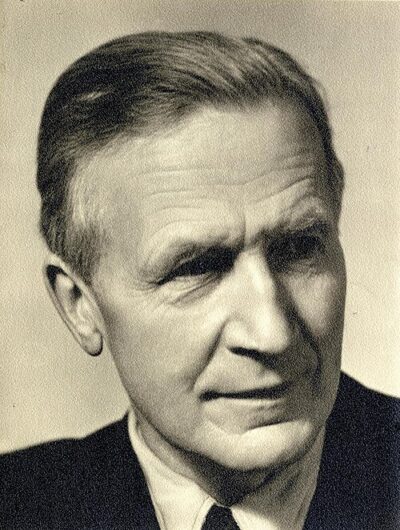
Paul Renner
Paul Renner was a German type designer. Born August 9, 1878, in Wernigerode. Died April 25, 1956, in Hödingen. Educated at Debschitz School and Academy of Fine Arts, Karlsruhe.
Facts
17 facts · 2 confirmed by two sources · 7 cited · 8 from one source
Where this comes from
Papalocal keeps its own record. It started from these sources; what each one said is kept here as it was copied, so a change on their side never changes this page by itself. Tap one to read its version.
What Wikidata says · copied November 18, 2026 · revision 2568757482
- Described as
- German type designer (1878–1959)
- Other names
- Paul Friedrich August Renner, Paul Friedrich Renner, Paul Friedrich A. Renner
- Born
- August 9, 1878 · 6 references
- Died
- April 25, 1956 · 4 references
- Born in
- Wernigerode · 1 reference
- Died in
- Hödingen · 1 reference
- Citizen of
- Germany
- Occupation
- type designer; typographer · 1 reference; graphic designer; printmaker; calligrapher · 1 reference; typesetter · 1 reference; artist · 1 reference; illustrator · 1 reference
- Worked for
- Technical University of Munich
- Education
- Debschitz School; Academy of Fine Arts, Karlsruhe
- Member of
- Deutscher Werkbund
- Wikipedias with a page
- 21
Wikidata item Q552409 (wikidata.org/wiki/Q552409), public domain (CC0). Copied November 18, 2026.
What Wikipedia says · copied November 18, 2026 · revision 1380285185
Paul Friedrich August Renner (9 August 1878 – 25 April 1956) was a German typeface designer, author, and founder of the Master School for Germany's Printers in Munich. In 1927, he designed the Futura typeface, which became one of the most successful and most-used types of the 20th century.
Renner was born in Wernigerode, and died in Hödingen (today part of Überlingen, Germany).
He had a strict Protestant upbringing, being educated in a 19th-century Gymnasium. He was brought up to have a sense of leadership, duty and responsibility. He disliked abstract art and many forms of modern culture, such as jazz, cinema, and dancing. But equally, he admired the functionalist strain in modernism. Thus, Renner can be seen as a bridge between the traditional (19th century) and the modern (20th century). He attempted to fuse the Gothic and the roman typefaces.
Renner was a prominent member of the Deutscher Werkbund (German Work Federation). Two of his major texts are Typografie als Kunst (Typography as Art) and Die Kunst der Typographie (The Art of Typography). He created a new set of guidelines for good book design and invented the popular Futura, a geometric sans-serif font used by many typographers throughout the 20th century and today. The typeface Architype Renner is based upon Renner's early experimental exploration of geometric letterforms for the Futura typeface, most of which were deleted from the face's character set before it was issued. Tasse, a 1994 typeface is a revival of Renner's 1953 typeface Steile Futura.
The Futura was used for the engraving on the Apollo 11 plaque left on the Moon in July 1969; the original composition, held by NASA, uses Futura for the commemorative text "Here men from the planet Earth first set foot upon the Moon".
Renner was a friend of the German typographer Jan Tschichold and a key participant in the heated ideological and artistic debates of that time.
- Born, in its opening lines
- August 9, 1878
- Died, in its opening lines
- April 25, 1956
From the Wikipedia article “Paul Renner (type designer)” (en.wikipedia.org/wiki/Paul_Renner_(type_designer)), by its contributors, under CC BY-SA 4.0 (creativecommons.org/licenses/by-sa/4.0/). Copied November 18, 2026; not changed.
Confirmed Two sources agree. Cited One source, and it names where it got it. One source One source, without a reference of its own. Sources disagree The sources disagree. We show the best-supported value and keep theirs below.
