
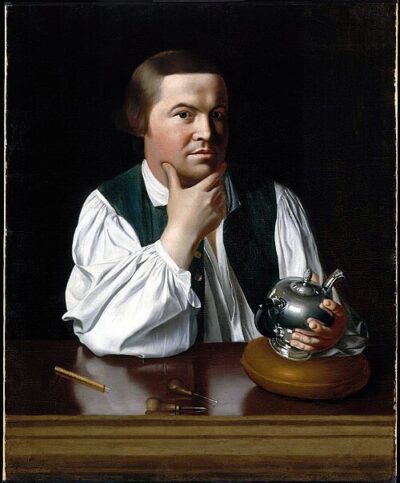
Paul Revere
Paul Revere was an American silversmith and Patriot in the American Revolution. Born December 21, 1734, in Boston. Died May 10, 1818, in Boston.
Facts
18 facts · 1 confirmed by two sources · 9 cited · 7 from one source · 1 where the sources disagree
What’s different
- Died: we show May 10, 1818 (Sources disagree). Wikipedia says January 1, 1735
Where this comes from
Papalocal keeps its own record. It started from these sources; what each one said is kept here as it was copied, so a change on their side never changes this page by itself. Tap one to read its version.
What Wikidata says · copied November 13, 2026 · revision 2558207815
- Described as
- American silversmith and Patriot in the American Revolution (1735–1818)
- Other names
- Paul Revere, Jr.
- Born
- December 21, 1734 · 1 reference
- Died
- May 10, 1818 · 5 references
- Born in
- Boston · 1 reference
- Died in
- Boston · 1 reference
- Buried in
- Granary Burying Ground
- Citizen of
- United States
- Occupation
- silversmith; entrepreneur; military personnel
- Spouse
- Rachel Walker (1773–1813) · 1 reference; Sarah Orne (1757–1773) · 2 references
- Children
- Joseph Warren Revere · 1 reference; Paul Revere, Jr. · 1 reference; Maria Revere Balestier
- Father
- Apollos Rivoire · 1 reference
- Mother
- Deborah Hitchbourn · 1 reference
- Military rank
- Lieutenant Colonel
- Lived in
- Paul Revere House (1770–1800) · 1 reference
- Wikipedias with a page
- 43
Wikidata item Q327071 (wikidata.org/wiki/Q327071), public domain (CC0). Copied November 13, 2026.
What Wikipedia says · copied November 13, 2026 · revision 1383673225
Paul Revere (December 21, 1734 O.S. (January 1, 1735 N.S.) – May 10, 1818) was an American silversmith, military officer and industrialist who played a major role during the opening months of the American Revolutionary War in Massachusetts, engaging in a midnight ride in 1775 to alert nearby minutemen of the approach of British troops prior to the battles of Lexington and Concord.
Born in the North End of Boston, Revere eventually became a prosperous and prominent Bostonian, deriving his income from silversmithing and engraving. During the American Revolution, he was a strong supporter of the Patriot cause and joined the Sons of Liberty. His midnight ride transformed him into an American folk hero, being dramatized in Henry Wadsworth Longfellow's 1861 poem "Paul Revere's Ride". He also helped to organize an intelligence and alarm system to keep watch on the movements of British forces. Revere later served as an officer in the Massachusetts Militia, though his service ended after the Penobscot Expedition, one of the most disastrous American campaigns of the American Revolutionary War, for which he was absolved of blame.
Following the war, Revere returned to his silversmith trade. He used the profits from his expanding business to finance his work in iron casting, bronze bell and cannon casting, and the forging of copper bolts and spikes. In 1800, he became the first American to successfully roll copper into sheets for use as sheathing on naval vessels.
- Born, in its opening lines
- December 21, 1734
- Died, in its opening lines
- January 1, 1735
From the Wikipedia article “Paul Revere” (en.wikipedia.org/wiki/Paul_Revere), by its contributors, under CC BY-SA 4.0 (creativecommons.org/licenses/by-sa/4.0/). Copied November 13, 2026; not changed.
Confirmed Two sources agree. Cited One source, and it names where it got it. One source One source, without a reference of its own. Sources disagree The sources disagree. We show the best-supported value and keep theirs below.
