
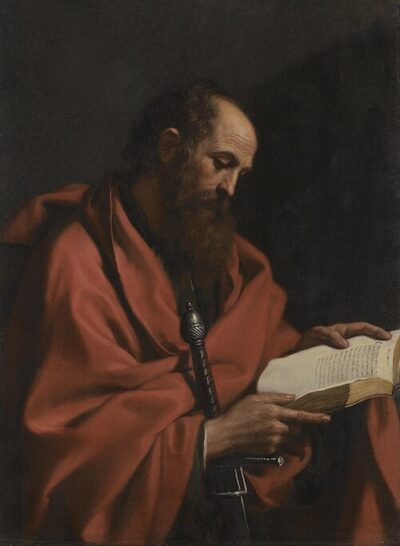
Paul the Apostle
Paul the Apostle was an Early Christian apostle and missionary (c. AD 5 – c. 64/65). Born 5, in Tarsus. Died 66, in Rome. Positions held include apostle (44–). Known for Pauline epistles.
Facts
23 facts · 0 confirmed by two sources · 15 cited · 7 from one source · 1 where the sources disagree
What’s different
- Name at birth: we show שאול התרסי (Sources disagree). Wikidata also lists Saulus Tarsensis
Where this comes from
Papalocal keeps its own record. It started from these sources; what each one said is kept here as it was copied, so a change on their side never changes this page by itself. Tap one to read its version.
What Wikidata says · copied November 16, 2026 · revision 2567600006
- Described as
- Early Christian apostle and missionary (c. AD 5 – c. 64/65)
- Other names
- Paulus of Tarsus, Šā'ûl, St. Paul, Paulos, Apostle Paul, The Apostle Paul, Paul of Tarsus, Saul, Paulus the Apostle, Saul of Tarsus, Saint Paul, Paulus Tarsensis
- Born
- 5 · 2 references
- Died
- 66 · 1 reference
- Born in
- Tarsus · 1 reference
- Died in
- Rome
- Buried in
- Basilica of Saint Paul outside the Walls · 1 reference
- Cause of death
- decapitation · 1 reference
- Name at birth
- שאול התרסי; Saulus Tarsensis
- Citizen of
- Ancient Rome · 1 reference
- Occupation
- writer · 2 references; theologian; missionary · 1 reference; artisan; apostle · 1 reference
- Positions held
- apostle (44–)
- Known for
- Pauline epistles
- Religion
- Pharisees · 1 reference; Christianity · 1 reference
- Lived in
- Tarsus · 1 reference; Jerusalem · 1 reference; Damascus · 1 reference; Antioch · 1 reference; Salamis · 1 reference
- Nickname
- Apostle of the Gentiles
- Wikipedias with a page
- 197
Wikidata item Q9200 (wikidata.org/wiki/Q9200), public domain (CC0). Copied November 16, 2026.
What Wikipedia says · copied November 16, 2026 · revision 1385858548
Paul (born Saul of Tarsus; c. 5 – c. 64/65 AD), commonly known as Paul the Apostle or Saint Paul, was a Christian apostle who spread the teachings of Jesus in the first century AD. For his contributions to the New Testament, he is generally regarded as one of the most important figures of the Apostolic Age, and he also founded several Christian communities in Asia Minor and Europe from the mid-40s to the mid-50s AD.
The main sources of information on Paul's life and works are Paul's letters and the Acts of the Apostles in the New Testament. Approximately half of their contents document his travels, preaching, and miracles. While he was not one of the Twelve Apostles and did not know Jesus during his lifetime, but claims to have met him post-resurrection, Paul was a contemporary of Jesus and personally knew eyewitnesses of Jesus such as his closest disciples (Peter and John) and brother James since the mid 30s AD, within a few years of the crucifixion (c. 30–33 AD). He had knowledge of the life of Jesus and his teachings. Paul argued over issues such as the circumcision of gentiles, while his exalted Christology was taken for granted and widely accepted in the early church. According to Acts, Paul was a Pharisee and participated in the persecution of early disciples of Jesus before his conversion. On his way to arrest Christians in Damascus, Paul saw a bright light, heard Christ speak, was blinded, and later healed by Ananias. After these events, Paul was baptized, beginning immediately to proclaim that Jesus of Nazareth was the Jewish messiah and the Son of God. He made three missionary journeys to spread the Christian message to non-Jewish communities.
Fourteen of the 27 books in the New Testament have traditionally been attributed to Paul. Seven of the Pauline epistles are undisputed by scholars as being authentic. Of the other six, Ephesians, 1 and 2 Timothy, and Titus are generally considered pseudepigraphical, while Colossians and 2 Thessalonians are debated. Pauline authorship of the Epistle to the Hebrews is almost universally rejected by scholars. The other six are believed by some scholars to have come from followers writing in his name, using material from Paul's surviving letters and letters written by him that no longer survive.
Today, Paul's epistles continue to be vital roots of the theology, worship, and pastoral life in the Latin and Protestant traditions of the West, as well as the Eastern Catholic and Orthodox traditions of the East. Paul's influence on Christian thought and practice is pervasive in scope and profound in impact. Christians, particularly in the Lutheran tradition, have read Paul as saying that people are saved through faith rather than by following Jewish law. He has been accused of corrupting or hijacking Christianity, often by introducing pagan or Hellenistic themes to the early church. There has been increasing acceptance of Paul as a fundamentally Jewish figure in line with the original disciples in Jerusalem over past interpretations, manifested through movements like "Paul Within Judaism".
From the Wikipedia article “Paul the Apostle” (en.wikipedia.org/wiki/Paul_the_Apostle), by its contributors, under CC BY-SA 4.0 (creativecommons.org/licenses/by-sa/4.0/). Copied November 16, 2026; not changed.
Confirmed Two sources agree. Cited One source, and it names where it got it. One source One source, without a reference of its own. Sources disagree The sources disagree. We show the best-supported value and keep theirs below.
