
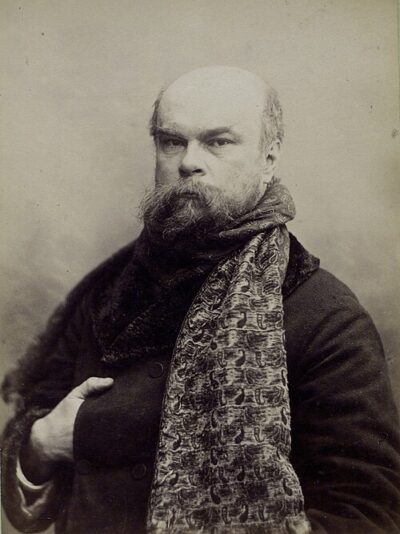
Paul Verlaine
Paul Verlaine was a French poet. Born March 30, 1844, in Metz. Died January 8, 1896, in Paris. Educated at Lycée Condorcet. Awards include Prince des poètes.
Facts
23 facts · 2 confirmed by two sources · 10 cited · 11 from one source
Where this comes from
Papalocal keeps its own record. It started from these sources; what each one said is kept here as it was copied, so a change on their side never changes this page by itself. Tap one to read its version.
What Wikidata says · copied November 16, 2026 · revision 2568844091
- Described as
- French poet (1844-1896)
- Other names
- Paul-Marie Verlaine, Paul Marie Verlaine
- Born
- March 30, 1844 · 17 references
- Died
- January 8, 1896 · 17 references
- Born in
- Metz · 3 references
- Died in
- Paris · 3 references
- Buried in
- Batignolles Cemetery
- Cause of death
- pneumonia
- Citizen of
- France
- Occupation
- poet · 2 references; essayist; writer · 2 references; librettist · 1 reference; translator · 1 reference
- Education
- Lycée Condorcet
- Genre
- lyric poetry
- Awards
- Prince des poètes
- Field
- literary activity · 1 reference; poetry · 1 reference; symbolism · 1 reference
- Spouse
- Mathilde Mauté
- Children
- Georges Verlaine
- Father
- Nicolas Verlaine
- Mother
- Élisa Verlaine · 1 reference
- Religion
- atheism
- Wikipedias with a page
- 118
Wikidata item Q755 (wikidata.org/wiki/Q755), public domain (CC0). Copied November 16, 2026.
What Wikipedia says · copied November 16, 2026 · revision 1384689472
Paul Marie Verlaine ( vair-LEN; French: [pɔl maʁi vɛʁlɛn]; 30 March 1844 – 8 January 1896) was a French poet, writer and critic associated with the Symbolist, Parnassianist and Decadent movements. He is considered one of the paramount exponents of the fin de siècle in French and international poetry.
Born in Metz to a petit-bourgeois family, Verlaine bore a lifelong interest in the arts, whether literary, musical or visual. His début collection, Poèmes saturniens (1866), were released at the age of twenty-two; they were published by Alphonse Lemerre. Verlaine's tempestuous sexual relationship with young poet Arthur Rimbaud (ten years his junior and under eighteen years, and while he himself had a wife and infant son), a fellow member of the Zutistes, aroused great controversy. The couple would peregrinate throughout England and Belgium until their split in 1873, which was caused by him wounding Rimbaud with a revolver. Following trial, Verlaine was sentenced to two years in prison for battery and sodomy. During his sentence, Verlaine reverted to practising Catholicism and composed Sagesse (published 1880), Jadis et naguère (published 1884) and Parallèlement (published 1889). As his reputation grew, he became increasingly haunted by guilt and paranoia, lapsing into depression, alcohol and chemical abuse and disease, culminating in his death in Paris from acute pneumonia.
Revered for his lyrical sensibility and subtlety in nuance, Verlaine is acknowledged as one of the archetypical poètes maudits ('accursed poets'), a phrase he popularised but did not coin. His promise was evident even in his early work: his engagement with musicality, fluidity, wordplay, polysemy and prosodical manipulation attracted much admiration. His œuvre is highly eclectic, exploiting the characteristics of the French language; critics have noted interplays with melancholy and chiaroscuro, as well as a pioneering of metaphor and allegory. Beyond these characteristics lies a profound introspection which resonated with many contemporaneous artists, including those outside the literary sphere (such as Impressionist painters).
Numerous composers have set Verlaine's poetry to music or used his work as inspiration for their compositions; they include Nadia Boulanger, Claude Debussy (Clair de lune inspired the third movement of Debussy's Suite bergamasque), Frederick Delius, Louis Durey, Gabriel Fauré (Cinq Mélodies "de Venise" and La Bonne Chanson), Léo Ferré (his album Verlaine et Rimbaud), Reynaldo Hahn, Arthur Honegger, Sigfrid Karg-Elert, Charles Koechlin, Jules Massenet, Olivier Messiaen, Poldowski, Maurice Ravel, Jeanne Rivet, Camille Saint-Saëns, Kaikhosru Shapurji Sorabji, Igor Stravinsky, Anna Teichmüller, Edgard Varèse (Un grand sommeil noir), Ralph Vaughan Williams, Louis Vierne and many more. Verlaine himself was aware of this and apparently pleased; he also wrote operatic libretti, particularly for Emmanuel Chabrier.
He was honoured with the title of Prince of Poets in 1894 following a referendum organised by Maurice Barrès consulting various people of letters.
- Born, in its opening lines
- March 30, 1844
- Died, in its opening lines
- January 8, 1896
From the Wikipedia article “Paul Verlaine” (en.wikipedia.org/wiki/Paul_Verlaine), by its contributors, under CC BY-SA 4.0 (creativecommons.org/licenses/by-sa/4.0/). Copied November 16, 2026; not changed.
Confirmed Two sources agree. Cited One source, and it names where it got it. One source One source, without a reference of its own. Sources disagree The sources disagree. We show the best-supported value and keep theirs below.
