
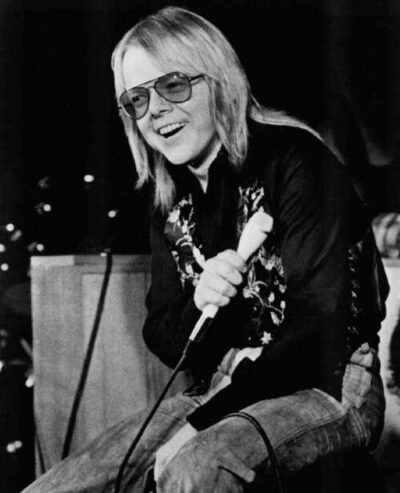
Paul Williams
Paul Williams is an American composer, singer, songwriter and actor. Born September 19, 1940, in Omaha. Known for We've Only Just Begun, Just an Old Fashioned Love Song and Phantom of the Paradise. Educated at University of California, Los Angeles and Woodrow Wilson Classical High School. Awards include star on Hollywood Walk of Fame, Academy Award for Best Original Song and ASCAP Film and Television Music Awards.
Facts
35 facts · 1 confirmed by two sources · 3 cited · 31 from one source
Where this comes from
Papalocal keeps its own record. It started from these sources; what each one said is kept here as it was copied, so a change on their side never changes this page by itself. Tap one to read its version.
What Wikidata says · copied November 16, 2026 · revision 2567825862
- Described as
- American composer, singer, songwriter and actor
- Other names
- Paul H. Williams, Paul Hamilton Williams Jr.
- Born
- September 19, 1940 · 1 reference
- Born in
- Omaha · 1 reference
- Name at birth
- Paul Hamilton Williams
- Citizen of
- United States
- Occupation
- actor · 2 references; screenwriter; composer · 1 reference; singer; film actor; television actor; songwriter; film score composer
- Education
- University of California, Los Angeles; Woodrow Wilson Classical High School · 1 reference
- Member of
- John Mayall & the Bluesbreakers
- Genre
- folk music; pop music; soft rock; film score
- Instrument
- voice
- Record label
- A&M Records
- Known for
- We've Only Just Begun; Just an Old Fashioned Love Song; Phantom of the Paradise; Smokey and the Bandit
- Awards
- star on Hollywood Walk of Fame · 1 reference; Academy Award for Best Original Song (1977); ASCAP Film and Television Music Awards (1986); Golden Globe Award for Best Original Score (1977); Golden Globe Award for Best Original Song (1976); Grammy Award for Song of the Year (1976); Grammy Award for Best Children's Music Album (1980); Satellite Auteur Award (2012); World Soundtrack Award for Best Original Song Written Directly for a Film (2015)
- Website
- http://www.paulwilliamsofficial.com/
- Wikipedias with a page
- 22
Wikidata item Q927415 (wikidata.org/wiki/Q927415), public domain (CC0). Copied November 16, 2026.
What Wikipedia says · copied November 16, 2026 · revision 1375574165
Paul Hamilton Williams Jr. (born September 19, 1940) is an American songwriter and actor. He is known for writing and co-writing popular songs performed by a number of acts in the 1970s, including Three Dog Night's "An Old Fashioned Love Song" and "Out in the Country", Helen Reddy's "You and Me Against the World", Biff Rose's "Fill Your Heart", and the Carpenters' "We've Only Just Begun" and "Rainy Days and Mondays". He also wrote "Cried Like a Baby" for teen idol Bobby Sherman.
Williams is also known for writing the score and lyrics for Bugsy Malone (1976) and his musical contributions to other films, including the Oscar-nominated song "Rainbow Connection" from The Muppet Movie, and writing the lyrics to the No. 1 chart-topping song "Evergreen", the love theme from the Barbra Streisand film A Star Is Born, for which he won a Grammy for Song of the Year and an Academy Award for Best Original Song. He wrote the lyrics to the opening theme for the television show The Love Boat, with music previously composed by Charles Fox, which was originally sung by Jack Jones and, later, by Dionne Warwick.
Williams has had a variety of high-profile acting roles, such as Little Enos Burdette in the action-comedy Smokey and the Bandit (1977) and the villainous Swan in Brian De Palma's Phantom of the Paradise (1974), which Williams also co-scored, receiving an Oscar nomination in the process. He also voiced the Penguin in several projects in the DC Animated Universe. Since 2009, Williams has been the president and chairman of the American songwriting society ASCAP.
- Born, in its opening lines
- September 19, 1940
From the Wikipedia article “Paul Williams (songwriter)” (en.wikipedia.org/wiki/Paul_Williams_(songwriter)), by its contributors, under CC BY-SA 4.0 (creativecommons.org/licenses/by-sa/4.0/). Copied November 16, 2026; not changed.
Confirmed Two sources agree. Cited One source, and it names where it got it. One source One source, without a reference of its own. Sources disagree The sources disagree. We show the best-supported value and keep theirs below.
