
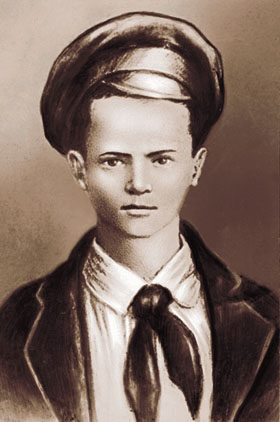
Pavlik Morozov
Pavlik Morozov was a Soviet murder victim. Born November 14, 1918, in Gerasimovka. Died September 3, 1932, in Gerasimovka. Awards include pioneer-hero.
Facts
7 facts · 2 confirmed by two sources · 0 cited · 5 from one source
Where this comes from
Papalocal keeps its own record. It started from these sources; what each one said is kept here as it was copied, so a change on their side never changes this page by itself. Tap one to read its version.
What Wikidata says · copied November 16, 2026 · revision 2521696850
- Described as
- Soviet murder victim (1918-1932)
- Other names
- Pavel Trofimovich Morozov
- Born
- November 14, 1918 · 1 reference
- Died
- September 3, 1932 · 1 reference
- Born in
- Gerasimovka
- Died in
- Gerasimovka
- Cause of death
- stabbing
- Citizen of
- Soviet Union
- Awards
- pioneer-hero
- Wikipedias with a page
- 35
Wikidata item Q311261 (wikidata.org/wiki/Q311261), public domain (CC0). Copied November 16, 2026.
What Wikipedia says · copied November 16, 2026 · revision 1383341489
Pavel Trofimovich Morozov (Russian: Па́вел Трофи́мович Моро́зов; 14 November 1918 – 3 September 1932), better known by the diminutive Pavlik, was a Soviet youth praised by the Soviet press as a martyr. Evidence has emerged since the dissolution of the Soviet Union of the fabrication of the Pavlik Morozov legend, as well as what Soviet officials thought of him. His story, dated to 1932, is that of a 13-year-old boy who denounced his father to the authorities and was in turn killed by his family. His story was a subject of reading, songs, plays, a symphonic poem, a full-length opera, and six biographies. His politicized and mythologized story was used to encourage Soviet Bloc children to also inform on their parents.
- Born, in its opening lines
- November 14, 1918
- Died, in its opening lines
- September 3, 1932
From the Wikipedia article “Pavlik Morozov” (en.wikipedia.org/wiki/Pavlik_Morozov), by its contributors, under CC BY-SA 4.0 (creativecommons.org/licenses/by-sa/4.0/). Copied November 16, 2026; not changed.
Confirmed Two sources agree. Cited One source, and it names where it got it. One source One source, without a reference of its own. Sources disagree The sources disagree. We show the best-supported value and keep theirs below.
