
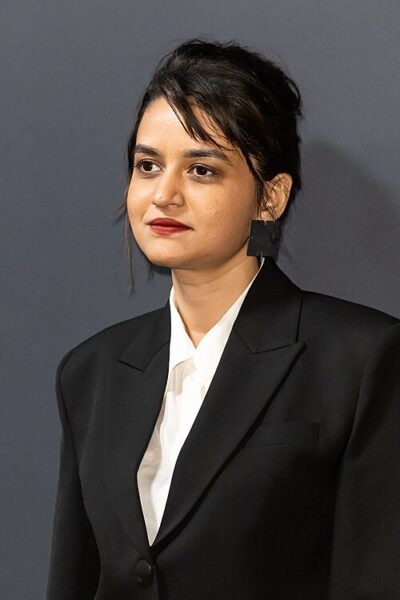
Payal Kapadia
Payal Kapadia is an Indian filmmaker. Born January 4, 1986, in Mumbai. Educated at Film and Television Institute of India and St. Xavier's College. Awards include Cannes Film Festival Grand Prix.
Facts
11 facts · 1 confirmed by two sources · 2 cited · 8 from one source
Where this comes from
Papalocal keeps its own record. It started from these sources; what each one said is kept here as it was copied, so a change on their side never changes this page by itself. Tap one to read its version.
What Wikidata says · copied November 18, 2026 · revision 2565540525
- Described as
- Indian filmmaker
- Born
- January 4, 1986 · 1 reference
- Born in
- Mumbai · 1 reference
- Citizen of
- India
- Occupation
- documentary filmmaker; film director · 1 reference; screenwriter
- Education
- Film and Television Institute of India; St. Xavier's College; Sophia College for Women
- Awards
- Cannes Film Festival Grand Prix (2024)
- Mother
- Nalini Malani
- Wikipedias with a page
- 23
Wikidata item Q107803283 (wikidata.org/wiki/Q107803283), public domain (CC0). Copied November 18, 2026.
What Wikipedia says · copied November 18, 2026 · revision 1382054192
Payal Kapadia (born 4 January 1986) is an Indian filmmaker. In 2017, her short film Afternoon Clouds was the only Indian film selected for the 70th Cannes Film Festival. In 2021, she won the Golden Eye award for best documentary film at the 74th Cannes Film Festival for her debut feature A Night of Knowing Nothing.
In 2024, she won the Grand Prix at the 77th Cannes Film Festival for her fiction feature debut All We Imagine as Light. It also earned her a nomination for the Golden Globe Award for Best Director.
- Born, in its opening lines
- January 4, 1986
From the Wikipedia article “Payal Kapadia (filmmaker)” (en.wikipedia.org/wiki/Payal_Kapadia_(filmmaker)), by its contributors, under CC BY-SA 4.0 (creativecommons.org/licenses/by-sa/4.0/). Copied November 18, 2026; not changed.
Confirmed Two sources agree. Cited One source, and it names where it got it. One source One source, without a reference of its own. Sources disagree The sources disagree. We show the best-supported value and keep theirs below.
