
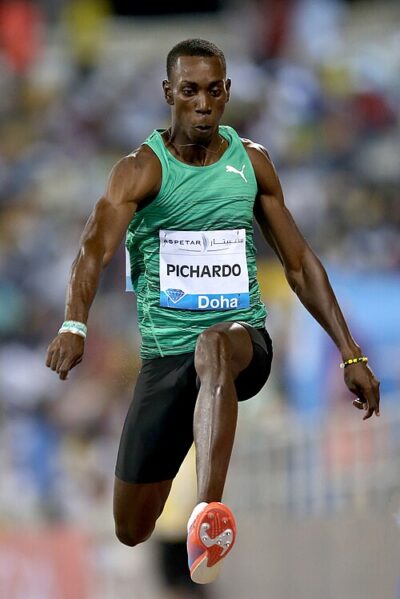
Pedro Pichardo is a Cuban triple jumper. Born June 30, 1993, in Santiago de Cuba.
Facts
7 facts · 1 confirmed by two sources · 2 cited · 4 from one source
Where this comes from
Papalocal keeps its own record. It started from these sources; what each one said is kept here as it was copied, so a change on their side never changes this page by itself. Tap one to read its version.
What Wikidata says · copied November 16, 2026 · revision 2569391297
- Described as
- Cuban triple jumper
- Other names
- Pedro Pablo Pichardo Peralta
- Born
- June 30, 1993 · 1 reference
- Born in
- Santiago de Cuba · 2 references
- Citizen of
- Portugal; Cuba
- Occupation
- athletics competitor · 1 reference
- Sport
- athletics
- Height
- 1.85 m (6 ft 1 in)
- Wikipedias with a page
- 33
Wikidata item Q3374111 (wikidata.org/wiki/Q3374111), public domain (CC0). Copied November 16, 2026.
What Wikipedia says · copied November 16, 2026 · revision 1381200774
Pedro Pablo Pichardo Peralta (Spanish pronunciation: [piˈtʃaɾðo], Portuguese pronunciation: [piˈʃaɾðu]; born 30 June 1993) is a Cuban-born Portuguese triple jumper. He won the gold medal at the 2020 Summer Olympics with a Portuguese national record of 17.98 m (58 ft 11+3⁄4 in) and the silver medal at the 2024 Summer Olympics. He was world champion in 2022, and could not defend his title in 2023 due to injury.
Pichardo was the 2012 World Junior Champion and the 2013 World Championship silver medalist. His 17.79 m (58 ft 4+1⁄4 in) in early 2014 was the best triple jump of the year. In 2015, his 17.94 m (58 ft 10+1⁄4 in) made him the #6 performer ever. A week later he improved to 18.06 m (59 ft 3 in), making him the No. 3 performer ever and the best performance the world has seen since 1996 (when Pichardo was only three years old).
- Born, in its opening lines
- June 30, 1993
From the Wikipedia article “Pedro Pichardo” (en.wikipedia.org/wiki/Pedro_Pichardo), by its contributors, under CC BY-SA 4.0 (creativecommons.org/licenses/by-sa/4.0/). Copied November 16, 2026; not changed.
Confirmed Two sources agree. Cited One source, and it names where it got it. One source One source, without a reference of its own. Sources disagree The sources disagree. We show the best-supported value and keep theirs below.
