
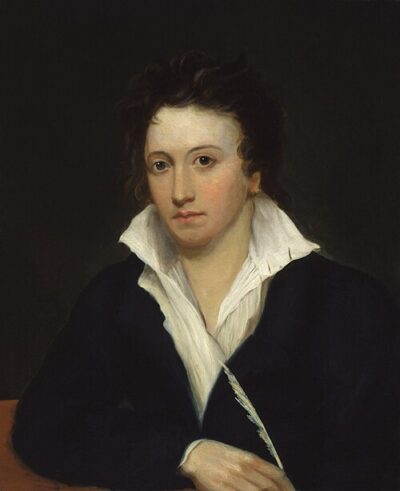
Percy Bysshe Shelley
Percy Bysshe Shelley was a British Romantic poet. Born August 4, 1792, in Horsham. Died July 8, 1822, in Gulf of La Spezia. Known for Ozymandias, Love's Philosophy and The Cloud. Educated at University College, Oxford and Eton College.
Facts
40 facts · 2 confirmed by two sources · 23 cited · 15 from one source
Where this comes from
Papalocal keeps its own record. It started from these sources; what each one said is kept here as it was copied, so a change on their side never changes this page by itself. Tap one to read its version.
What Wikidata says · copied November 16, 2026 · revision 2560348348
- Described as
- British Romantic poet (1792–1822)
- Other names
- Percy Shelley, Percy Byssche Shelley, Shelli Persi Bish
- Born
- August 4, 1792 · 16 references
- Died
- July 8, 1822 · 17 references
- Born in
- Horsham · 5 references
- Died in
- Gulf of La Spezia
- Buried in
- Protestant Cemetery, Rome · 1 reference
- Cause of death
- drowning · 1 reference
- Citizen of
- United Kingdom of Great Britain and Ireland; Kingdom of Great Britain (–1801); Kingdom of Italy · 1 reference; Switzerland · 1 reference
- Occupation
- linguist; poet · 3 references; translator; playwright; novelist; writer · 3 references; librettist · 2 references
- Education
- University College, Oxford (1810–) · 1 reference; Eton College (1804–) · 1 reference
- Genre
- Romantic poetry
- Known for
- Ozymandias; Love's Philosophy; The Cloud; Prometheus Unbound · 1 reference
- Spouse
- Mary Shelley (1816–1822) · 3 references; Harriet Westbrook (1811–1816) · 2 references
- Children
- Ianthe Eliza Shelley · 3 references; Charles Bysshe Shelley · 3 references; William Shelley · 3 references; Percy Florence Shelley · 2 references; Clara Everina Shelley · 2 references; Clara Shelley · 2 references
- Father
- Timothy Shelley · 1 reference
- Mother
- Elizabeth Pilfold · 2 references
- Siblings
- Helen Shelley · 1 reference; Margaret Shelley · 1 reference; John Shelley · 1 reference; Elizabeth Shelley
- Religion
- atheism
- Lived in
- Elan Valley
- Wikipedias with a page
- 143
Wikidata item Q93343 (wikidata.org/wiki/Q93343), public domain (CC0). Copied November 16, 2026.
What Wikipedia says · copied November 16, 2026 · revision 1385247868
Percy Bysshe Shelley ( BISH; 4 August 1792 – 8 July 1822) was an English writer who is considered one of the major English Romantic poets. A radical in his poetry as well as in his political and social views, Shelley did not achieve fame during his lifetime, but recognition of his achievements in poetry grew steadily following his death, and he became an important influence on subsequent generations of poets, including Robert Browning, Algernon Charles Swinburne, Thomas Hardy, and W. B. Yeats. American literary critic Harold Bloom describes him as "a superb craftsman, a lyric poet without rival, and surely one of the most advanced sceptical intellects ever to write a poem."
Shelley's reputation fluctuated during the 20th century, but since the 1960s he has achieved increasing critical acclaim for the sweeping momentum of his poetic imagery, his mastery of genres and verse forms, and the complex interplay of sceptical, idealist, and materialist ideas in his work. Among his best-known poetic works are the long poems Alastor, or The Spirit of Solitude (1816), Julian and Maddalo (1818–19), The Mask of Anarchy (1819), Adonais (1821) and The Triumph of Life (1822); the short poems "Ozymandias" (1818), "Ode to the West Wind" (1819) and "To a Skylark" (1820); and the verse dramas The Cenci (1819), Prometheus Unbound (1820) and Hellas (1822).
Shelley also wrote prose fiction and a quantity of essays on political, social, and philosophical issues. Much of this poetry and prose was not published in his lifetime, or only published in expurgated form, due to the risk of prosecution for political and religious libel. From the 1820s, his poems and political and ethical writings became popular in Owenist, Chartist, and radical political circles, and later drew admirers as diverse as Karl Marx, Mahatma Gandhi, and George Bernard Shaw.
Shelley's life was marked by family crises, ill health, and a backlash against his avowed atheism, political views, and defiance of social conventions. He went into permanent self-exile in Italy in 1818 and over the next four years produced what Zachary Leader and Michael O'Neill call "some of the finest poetry of the Romantic period". His second wife, Mary Shelley, was the author of Frankenstein. He died in a boating accident in 1822 at age 29.
- Born, in its opening lines
- August 4, 1792
- Died, in its opening lines
- July 8, 1822
From the Wikipedia article “Percy Bysshe Shelley” (en.wikipedia.org/wiki/Percy_Bysshe_Shelley), by its contributors, under CC BY-SA 4.0 (creativecommons.org/licenses/by-sa/4.0/). Copied November 16, 2026; not changed.
Confirmed Two sources agree. Cited One source, and it names where it got it. One source One source, without a reference of its own. Sources disagree The sources disagree. We show the best-supported value and keep theirs below.
