
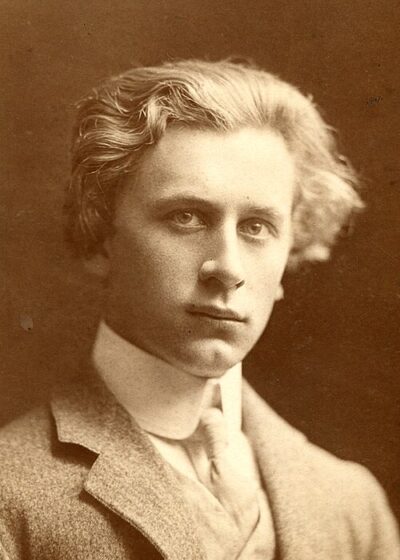
Percy Grainger
Percy Grainger was an Australian-born composer, arranger and pianist. Born July 8, 1882, in Brighton. Died February 20, 1961, in White Plains. Known for County Derry Air, Afterword and Shallow Brown. Educated at Hoch Conservatory. Awards include St. Olav's Medal.
Facts
29 facts · 2 confirmed by two sources · 8 cited · 19 from one source
Where this comes from
Papalocal keeps its own record. It started from these sources; what each one said is kept here as it was copied, so a change on their side never changes this page by itself. Tap one to read its version.
What Wikidata says · copied November 15, 2026 · revision 2563865170
- Described as
- Australian-born composer, arranger and pianist (1882–1961)
- Other names
- Percy Aldridge Grainger, George Percy Grainger
- Born
- July 8, 1882 · 10 references
- Died
- February 20, 1961 · 10 references
- Born in
- Brighton · 1 reference
- Died in
- White Plains · 1 reference
- Buried in
- West Terrace Cemetery
- Citizen of
- Australia; United States · 1 reference
- Occupation
- pianist · 1 reference; composer · 2 references; saxophonist · 1 reference; conductor · 1 reference; musicologist; ethnomusicologist; university teacher
- Worked for
- New York University
- Education
- Hoch Conservatory
- Member of
- American Academy of Arts and Letters
- Genre
- classical music · 1 reference
- Instrument
- saxophone; piano
- Known for
- County Derry Air; Afterword; Shallow Brown
- Awards
- St. Olav's Medal (1954) · 1 reference
- Father
- John Harry Grainger
- Mother
- Rose Annie Aldridge · 1 reference
- Religion
- atheism
- Military branch
- United States Army
- Lived in
- Percy Grainger Home and Studio (1921–1961) · 1 reference
- Wikipedias with a page
- 33
Wikidata item Q318354 (wikidata.org/wiki/Q318354), public domain (CC0). Copied November 15, 2026.
What Wikipedia says · copied November 15, 2026 · revision 1383683109
Percy Aldridge Grainger (born George Percy Grainger; 8 July 1882 – 20 February 1961) was an Australian-born composer, arranger and pianist who moved to the United States in 1914 and became an American citizen in 1918. In the course of a long and innovative career he played a prominent role in the revival of interest in British folk music in the early years of the 20th century. Although much of his work was experimental and unusual, the piece with which he is most generally associated is his piano arrangement of the folk-dance tune "Country Gardens".
Grainger left Australia at the age of 13 to attend the Hoch Conservatory in Frankfurt. Between 1901 and 1914 he was based in London, where he established himself first as a society pianist and later as a concert performer, composer, and collector of original folk melodies. As his reputation grew he met many of the significant figures in European music, forming important friendships with Frederick Delius and Edvard Grieg. He became a champion of Nordic music and culture, his enthusiasm for which he often expressed in private letters, sometimes in crudely racist or antisemitic terms.
In 1914 Grainger moved to the United States, where he lived for the rest of his life, though he travelled widely in Europe and Australia. He served briefly as a bandsman in the United States Army during the First World War through 1917–1918, and took American citizenship in 1918. After his mother's suicide in 1922, he became increasingly involved in educational work. He also experimented with music machines, which he hoped would supersede human interpretation.
In the 1930s, he set up the Grainger Museum in Melbourne, his birthplace, as a monument to his life and works, and as a future research archive. As he grew older, he continued to give concerts and to revise and rearrange his own compositions, while writing little new music. After the Second World War, ill health reduced his level of activity and he considered his career a failure. He gave his last concert in 1960, less than a year before his death.
- Born, in its opening lines
- July 8, 1882
- Died, in its opening lines
- February 20, 1961
From the Wikipedia article “Percy Grainger” (en.wikipedia.org/wiki/Percy_Grainger), by its contributors, under CC BY-SA 4.0 (creativecommons.org/licenses/by-sa/4.0/). Copied November 15, 2026; not changed.
Confirmed Two sources agree. Cited One source, and it names where it got it. One source One source, without a reference of its own. Sources disagree The sources disagree. We show the best-supported value and keep theirs below.
