
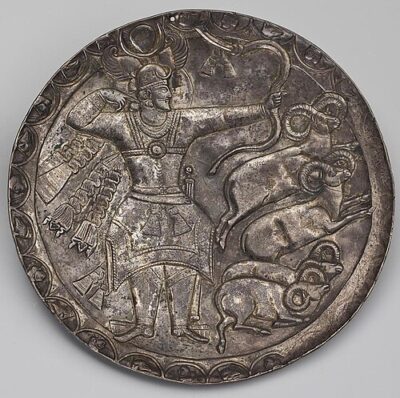
Peroz I
Peroz I was The 18th Sasanian Emperor. Born 5th century. Died 484, in Herat. Positions held include emperor of the Sasanian Empire (459–484).
Facts
15 facts · 0 confirmed by two sources · 0 cited · 13 from one source · 2 where the sources disagree
What’s different
- Born: we show 5th century (Sources disagree). Wikipedia says 438
- Died: we show 484 (Sources disagree). Wikipedia says 457
Where this comes from
Papalocal keeps its own record. It started from these sources; what each one said is kept here as it was copied, so a change on their side never changes this page by itself. Tap one to read its version.
What Wikidata says · copied November 16, 2026 · revision 2553927941
- Described as
- The 18th Sasanian Emperor (459–484)
- Born
- 5th century
- Died
- 484
- Died in
- Herat
- Citizen of
- Sasanian Empire
- Occupation
- monarch
- Positions held
- emperor of the Sasanian Empire (459–484)
- Children
- Kavad I; Jamasp; Perozdukht
- Father
- Yazdegerd II
- Mother
- Diang of Persia · 1 reference
- Siblings
- Hormizd III; Balash; Zarir
- Religion
- Zoroastrianism
- Wikipedias with a page
- 44
Wikidata item Q310233 (wikidata.org/wiki/Q310233), public domain (CC0). Copied November 16, 2026.
What Wikipedia says · copied November 16, 2026 · revision 1370924823
Peroz I (Middle Persian: 𐭯𐭩𐭫𐭥𐭰, romanized: Pērōz) was the Sasanian King of Kings (shahanshah) of Iran from 459 to 484. A son of Yazdegerd II (r. 438–457), he rejected the rule of his elder brother and incumbent king Hormizd III (r. 457–459), eventually seizing the throne after a two-year struggle. His reign was marked by war and famine. Early in his reign, he successfully quelled a rebellion in Caucasian Albania in the west, and put an end to the Kidarites in the east, briefly expanding Sasanian rule into Tokharistan, where he issued gold coins with his likeness in Balkh. At the same time Iran was suffering from a seven-year famine. He soon clashed with the former subjects of the Kidarites: the Hephthalites, who possibly would have helped him gain the throne initially. He was defeated and captured twice by the Hephthalites and as a result lost his recently acquired gains.
In 482, revolts broke out in the western provinces of Armenia and Iberia, led by Vahan Mamikonian and Vakhtang I respectively. Before Peroz could quell the unrest there, he was defeated and killed in his third war with the Hephthalites in 484, who seized the main Sasanian cities of the eastern region of Khorasan−Nishapur, Herat and Marw. Taking advantage of the weakened Sasanian position in the east, the Nezak Huns subsequently seized the region of Zabulistan. Peroz was the last shahanshah to mint unique gold coins in the Indian region of Sindh, which indicates that the region was lost around the same period. Albeit a devout Zoroastrian, Peroz supported the newly established Christian sect of Nestorianism, and just before his death, it was declared the official doctrine of the Iranian church.
Peroz's wars against the Hephthalites have been described as "foolhardy" in both contemporary and modern historiography. His defeat and death initiated a period of political, social and religious tumult. The empire reached its lowest ebb; the shahanshah was now a client of the Hephthalites and was compelled to pay tribute, while the nobility and clergy exerted great influence and authority over the nation, being able to act as king-makers. The magnates—most notably Sukhra and Shapur Mihran—elected Peroz's brother, Balash, as the new shahanshah. Order would first be restored under Peroz's son Kavad I (r. 488–496, 498/9–531), who reformed the empire and defeated the Hephthalites, reconquering Khorasan. By 560, Peroz had been avenged by his grandson Khosrow I (r. 531–579), who with the help of the First Turkic Khaganate, destroyed the Hephthalites.
- Born, in its opening lines
- 438
- Died, in its opening lines
- 457
From the Wikipedia article “Peroz I” (en.wikipedia.org/wiki/Peroz_I), by its contributors, under CC BY-SA 4.0 (creativecommons.org/licenses/by-sa/4.0/). Copied November 16, 2026; not changed.
Confirmed Two sources agree. Cited One source, and it names where it got it. One source One source, without a reference of its own. Sources disagree The sources disagree. We show the best-supported value and keep theirs below.
