
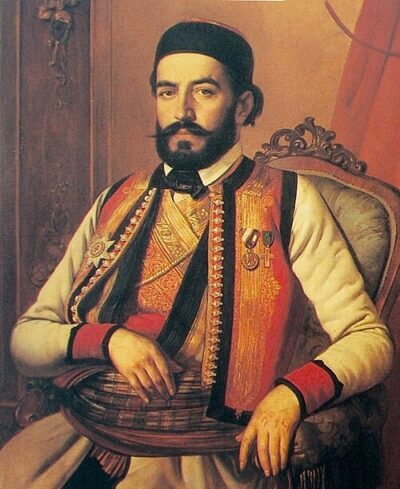
Petar II Petrović-Njegoš
Petar II Petrović-Njegoš was a Prince-Bishop of Montenegro. Born November 1, 1813, in Njeguši. Died October 19, 1851, in Cetinje. Positions held include monarch. Awards include Order of Saint Anna, 1st class.
Facts
18 facts · 0 confirmed by two sources · 6 cited · 10 from one source · 2 where the sources disagree
What’s different
- Born: we show November 1, 1813 (Sources disagree). Wikipedia says November 13, 1813
- Died: we show October 19, 1851 (Sources disagree). Wikipedia says October 31, 1851
Where this comes from
Papalocal keeps its own record. It started from these sources; what each one said is kept here as it was copied, so a change on their side never changes this page by itself. Tap one to read its version.
What Wikidata says · copied November 16, 2026 · revision 2558213286
- Described as
- Prince-Bishop of Montenegro
- Other names
- Peter II Petrovic-Njegoš, Prince of Montenegro
- Born
- November 1, 1813 · 1 reference
- Died
- October 19, 1851 · 1 reference
- Born in
- Njeguši
- Died in
- Cetinje · 2 references
- Buried in
- Njegoš Testament Church (1855–1916); Lovćen (1925–1974); Mausoleum of Njegoš (1974–)
- Cause of death
- tuberculosis
- Citizen of
- Prince-Bishopric of Montenegro
- Occupation
- poet · 1 reference; writer · 1 reference; philosopher · 1 reference; Eastern Orthodox priest · 1 reference
- Positions held
- monarch
- Member of
- Society of Serbian Letters (1842–1851) · 1 reference
- Awards
- Order of Saint Anna, 1st class
- Father
- Tomislav Petrovic-Njegoš · 1 reference
- Religion
- Eastern Orthodoxy
- Wikipedias with a page
- 45
Wikidata item Q362081 (wikidata.org/wiki/Q362081), public domain (CC0). Copied November 16, 2026.
What Wikipedia says · copied November 16, 2026 · revision 1385823970
Petar II Petrović-Njegoš (Serbian Cyrillic: Петар II Петровић-Његош, pronounced [pětar drûɡi pětroʋitɕ ɲêɡoʃ]; 13 November [O.S. 1 November] 1813 – 31 October [O.S. 19 October] 1851) was a Serbian Prince-Bishop (vladika) of Montenegro, poet and philosopher whose works are widely considered some of the most important in Montenegrin and Serbian literature.
Njegoš was born in the village of Njeguši, near Montenegro's then-capital Cetinje. He was educated at several Serbian monasteries and became the country's spiritual and political leader following the death of his uncle Petar I. After eliminating all initial domestic opposition to his rule, he concentrated on uniting Montenegro's tribes and establishing a centralized state. He introduced regular taxation, formed a personal guard and implemented a series of new laws to replace those composed by his predecessor many years earlier. His taxation policies proved extremely unpopular with the tribes of Montenegro and were the cause of several revolts during his lifetime. Njegoš's reign was also defined by the constant political and military struggle with the Ottoman Empire, and by his attempts to expand Montenegro's territory while gaining unconditional recognition from the Sublime Porte. He was a proponent of uniting and liberating the Serb people, willing to concede his princely rights in exchange for a union with Serbia and his recognition as the religious leader of all Serbs (akin to a modern-day Patriarch of the Serbian Orthodox Church). Although unification between the two states did not occur during his lifetime, Njegoš laid some of the foundations of Yugoslavism and introduced modern political concepts to Montenegro. Venerated as a poet and philosopher, Njegoš is well known for his epic poem Gorski vijenac (The Mountain Wreath), which is considered a masterpiece of Serbian and other South Slavic literature, and the national epic of Serbia, Montenegro, and Yugoslavia. Njegoš has remained influential in Serbia and Montenegro, as well in neighboring countries.
- Born, in its opening lines
- November 13, 1813
- Died, in its opening lines
- October 31, 1851
From the Wikipedia article “Petar II Petrović-Njegoš” (en.wikipedia.org/wiki/Petar_II_Petrović-Njegoš), by its contributors, under CC BY-SA 4.0 (creativecommons.org/licenses/by-sa/4.0/). Copied November 16, 2026; not changed.
Confirmed Two sources agree. Cited One source, and it names where it got it. One source One source, without a reference of its own. Sources disagree The sources disagree. We show the best-supported value and keep theirs below.
