
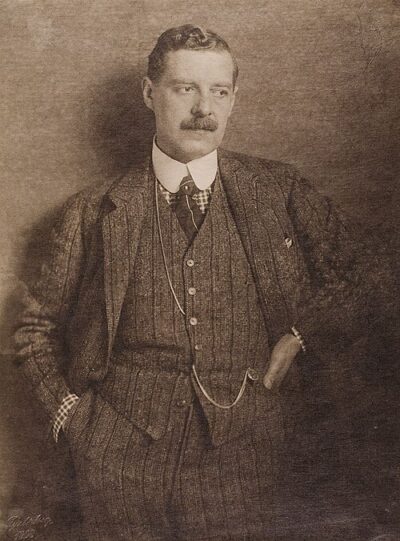
Peter Behrens
Peter Behrens was a German architect and designer. Born April 14, 1868, in Hamburg. Died February 27, 1940, in Berlin. Known for Eduard-Müller-Krematorium, Haus Wiegand and Mannesmann-Haus. Educated at Beaux-Arts de Paris and Academy of Fine Arts, Karlsruhe.
Facts
42 facts · 2 confirmed by two sources · 24 cited · 16 from one source
Where this comes from
Papalocal keeps its own record. It started from these sources; what each one said is kept here as it was copied, so a change on their side never changes this page by itself. Tap one to read its version.
What Wikidata says · copied November 16, 2026 · revision 2569142996
- Described as
- German architect and designer (1868-1940)
- Born
- April 14, 1868 · 17 references
- Died
- February 27, 1940 · 14 references
- Born in
- Hamburg · 3 references
- Died in
- Berlin · 3 references
- Buried in
- Wilmersdorf Cemetery
- Cause of death
- myocardial infarction
- Citizen of
- German Reich; Hamburg · 2 references
- Occupation
- poster artist · 1 reference; architect · 4 references; typographer · 1 reference; painter · 3 references; designer · 3 references; graphic designer · 1 reference; university teacher · 1 reference; graphic artist · 2 references
- Worked for
- Academy of Fine Arts Vienna (1921–1936) · 1 reference; Kunstgewerbeschule Düsseldorf (1903–1907) · 1 reference
- Education
- Beaux-Arts de Paris; Academy of Fine Arts, Karlsruhe (1885–1887) · 1 reference; Kunstakademie Düsseldorf (1888–1892) · 1 reference; Christianeum
- Member of
- Deutscher Werkbund; Gesellschaft für Goldschmiedekunst · 1 reference
- Known for
- Eduard-Müller-Krematorium; Haus Wiegand; Mannesmann-Haus; AEG’s Turbine factory; AEG-Montagehalle für Großgeräte (–1912); AEG-Kleinmotorenfabrik (–1912); Neue Fabrik für Bahnmaterial; house Behrens; Embassy of Germany, Saint Petersburg
- Field
- architecture · 1 reference; visual arts · 1 reference; educational system · 1 reference; industrial design right · 1 reference; industrial design · 1 reference
- Spouse
- Lilli Behrens · 1 reference
- Children
- Josef Behrens; Petra Fiedler · 1 reference
- Lived in
- house Behrens (1901–) · 1 reference
- Wikipedias with a page
- 54
Wikidata item Q76726 (wikidata.org/wiki/Q76726), public domain (CC0). Copied November 16, 2026.
What Wikipedia says · copied November 16, 2026 · revision 1372547944
Peter Behrens (14 April 1868 – 27 February 1940) was a leading German architect, graphic and industrial designer, best known for his early pioneering AEG Turbine Hall in Berlin in 1909. He had a long career, designing objects, typefaces, and important buildings in a range of styles from the 1900s to the 1930s. He was a founding member of the German Werkbund in 1907, when he also began designing for AEG, pioneered corporate design, graphic design, producing typefaces, objects, and buildings for the company. In the next few years, he became a successful architect, a leader of the rationalist / classical German Reform Movement of the 1910s. After the First World War, he turned to Brick Expressionism, designing the remarkable Hoechst Administration Building outside Frankfurt, and from the mid-1920s increasingly to New Objectivity. He was also an educator, heading the architecture school at Academy of Fine Arts Vienna from 1922 to 1936. As a well known architect he produced design across Germany, in other European countries, Russia and England. Several of the leading names of European modernism worked for him when they were starting out in the 1910s, including Ludwig Mies van der Rohe, Le Corbusier and Walter Gropius.
- Born, in its opening lines
- April 14, 1868
- Died, in its opening lines
- February 27, 1940
From the Wikipedia article “Peter Behrens” (en.wikipedia.org/wiki/Peter_Behrens), by its contributors, under CC BY-SA 4.0 (creativecommons.org/licenses/by-sa/4.0/). Copied November 16, 2026; not changed.
Confirmed Two sources agree. Cited One source, and it names where it got it. One source One source, without a reference of its own. Sources disagree The sources disagree. We show the best-supported value and keep theirs below.
