
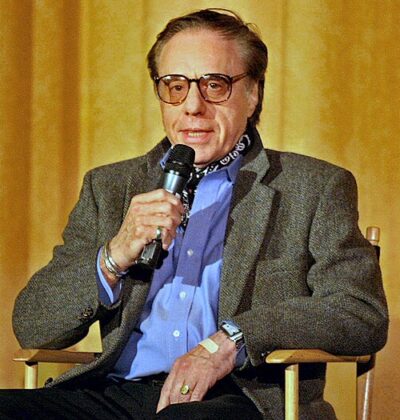
Peter Bogdanovich
Peter Bogdanovich was an American film director. Born July 30, 1939, in Kingston. Died January 6, 2022, in Studio City. Educated at Collegiate School and Stella Adler Studio of Acting. Awards include BAFTA Award for Best Screenplay, Grammy Awards and Commander of the Military Order of Saint James of the Sword.
Facts
31 facts · 2 confirmed by two sources · 6 cited · 23 from one source
Where this comes from
Papalocal keeps its own record. It started from these sources; what each one said is kept here as it was copied, so a change on their side never changes this page by itself. Tap one to read its version.
What Wikidata says · copied November 13, 2026 · revision 2565146289
- Described as
- American film director (1939–2022)
- Born
- July 30, 1939 · 7 references
- Died
- January 6, 2022 · 2 references
- Born in
- Kingston · 2 references
- Died in
- Studio City
- Buried in
- Westwood Village Memorial Park Cemetery
- Cause of death
- Parkinson's disease · 1 reference
- Citizen of
- United States · 1 reference
- Occupation
- actor; film director · 1 reference; screenwriter; film producer; camera operator; film editor; writer; journalist
- Education
- Collegiate School; Stella Adler Studio of Acting
- Member of
- Writers Guild of America West
- Genre
- documentary film · 1 reference; drama fiction · 1 reference
- Awards
- BAFTA Award for Best Screenplay (1973); Grammy Awards · 1 reference; Commander of the Military Order of Saint James of the Sword; Silver Shell for Best Director (1973) · 1 reference
- Field
- film · 1 reference; film direction · 1 reference
- Spouse
- Louise Stratten (1988–2001); Polly Platt (1962–1971)
- Children
- Antonia Bogdanovich; Sashy Bogdanovich
- Height
- 1.78 m (5 ft 10 in) · 1 reference
- Wikipedias with a page
- 53
Wikidata item Q158250 (wikidata.org/wiki/Q158250), public domain (CC0). Copied November 13, 2026.
What Wikipedia says · copied November 13, 2026 · revision 1383153850
Peter Bogdanovich (July 30, 1939 – January 6, 2022) was an American filmmaker, actor, critic, and film historian. He started out his career as a young actor studying under Stella Adler before working as a journalist for Film Culture and Esquire and finally becoming a prominent filmmaker of the New Hollywood movement. He received accolades including a BAFTA Award and Grammy Award, as well as nominations for two Academy Awards and two Golden Globe Awards.
Bogdanovich worked as a film journalist until he was hired to work on Roger Corman's The Wild Angels (1966). His credited feature film debut came with Targets (1968), before his career breakthrough with the drama The Last Picture Show (1971) which earned him Academy Award nominations for Best Director and Best Adapted Screenplay, and the acclaimed films What's Up, Doc? (1972) and Paper Moon (1973). Other films include Saint Jack (1979), They All Laughed (1981), Mask (1985), Noises Off (1992), The Cat's Meow (2001), and She's Funny That Way (2014).
As an actor, Bogdanovich was known for his roles in the HBO series The Sopranos and Orson Welles' last film, The Other Side of the Wind (2018), which he also helped finish.
Bogdanovich directed documentaries such as Directed by John Ford (1971) and The Great Buster: A Celebration (2018). He received a Grammy Award for Best Music Film for directing Runnin' Down a Dream (2007), a documentary about Tom Petty and the Heartbreakers. He also published numerous books, some of which include in-depth interviews with friends Howard Hawks, Alfred Hitchcock, and Orson Welles. Bogdanovich's works have been cited as important influences by many major filmmakers.
- Born, in its opening lines
- July 30, 1939
- Died, in its opening lines
- January 6, 2022
From the Wikipedia article “Peter Bogdanovich” (en.wikipedia.org/wiki/Peter_Bogdanovich), by its contributors, under CC BY-SA 4.0 (creativecommons.org/licenses/by-sa/4.0/). Copied November 13, 2026; not changed.
Confirmed Two sources agree. Cited One source, and it names where it got it. One source One source, without a reference of its own. Sources disagree The sources disagree. We show the best-supported value and keep theirs below.
