
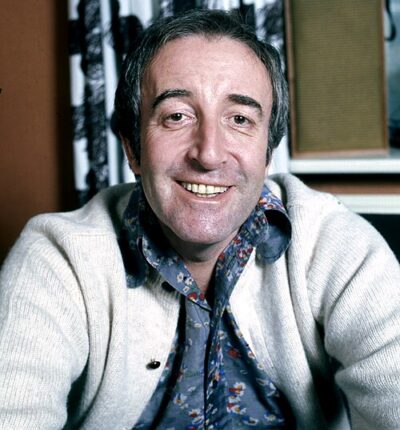
Peter Sellers
Peter Sellers was a British actor and comedian. Born September 8, 1925, in Southsea. Died July 24, 1980, in Middlesex Hospital. Educated at St Aloysius RC College. Awards include Commander of the Order of the British Empire and Golden Globes.
Facts
32 facts · 2 confirmed by two sources · 5 cited · 24 from one source · 1 where the sources disagree
What’s different
- Name at birth: we show Richard Henry Seller (Sources disagree). Wikidata also lists Richard Henry Sellers
Where this comes from
Papalocal keeps its own record. It started from these sources; what each one said is kept here as it was copied, so a change on their side never changes this page by itself. Tap one to read its version.
What Wikidata says · copied November 16, 2026 · revision 2566713181
- Described as
- British actor and comedian (1925–1980)
- Other names
- Richard Henry Seller, Peter Richard Henry Sellers, Richard Henry Sellers
- Born
- September 8, 1925 · 13 references
- Died
- July 24, 1980 · 11 references
- Born in
- Southsea
- Died in
- Middlesex Hospital
- Buried in
- Golders Green Crematorium
- Cause of death
- myocardial infarction
- Name at birth
- Richard Henry Sellers; Richard Henry Seller · 2 references
- Citizen of
- United Kingdom
- Occupation
- television actor; film actor; actor · 3 references; comedian · 1 reference; banjoist; film director; screenwriter; singer
- Education
- St Aloysius RC College
- Genre
- comedy film
- Awards
- Commander of the Order of the British Empire; Golden Globes · 1 reference
- Spouse
- Anne Hayes (1951–1963) · 1 reference; Britt Ekland (1964–1968); Miranda, Countess of Stockton (1970–1976) · 1 reference; Lynne Frederick (1977–1980) · 1 reference
- Children
- Michael Sellers; Sarah Sellers; Victoria Sellers
- Father
- William Sellers · 1 reference
- Mother
- Agnes Doreen Marks · 1 reference
- Military branch
- Royal Air Force
- Height
- 1.73 m (5 ft 8 in)
- Website
- http://www.petersellers.com/
- Wikipedias with a page
- 94
Wikidata item Q177984 (wikidata.org/wiki/Q177984), public domain (CC0). Copied November 16, 2026.
What Wikipedia says · copied November 16, 2026 · revision 1385194949
Peter Sellers (born Richard Henry Sellers; 8 September 1925 – 24 July 1980) was an English actor and comedian. He first came to prominence with his performances on the BBC Radio comedy series The Goon Show. Sellers was featured on a number of hit comic songs and became internationally acclaimed for his film roles, most notably as Chief Inspector Clouseau in The Pink Panther series.
Sellers made his stage debut at the Kings Theatre, Southsea, as an infant, and began accompanying his parents in a touring variety act. He worked as a drummer and toured around England as a member of the Entertainments National Service Association (ENSA). He developed his mimicry and improvisational skills during a spell in Ralph Reader's wartime Gang Show entertainment troupe. After the war, Sellers made his radio debut in ShowTime, and eventually became a regular performer on various BBC Radio shows. In 1951, Sellers, along with Spike Milligan, Harry Secombe, and Michael Bentine, began starring in the successful radio series The Goon Show, which ended in 1960.
Sellers began his film career during the 1950s. Although the bulk of his work was comedic, often parodying characters of authority such as military officers or policemen, he also performed in other film genres. Films demonstrating his artistic range include The Ladykillers (1955), The Mouse That Roared (1959), I'm All Right Jack (1959), The Millionairess (1960), Lolita (1962), five films of the Pink Panther series (1963–1978), Dr. Strangelove (1964), What's New Pussycat? (1965), Casino Royale (1967), The Party (1968), I Love You, Alice B. Toklas (1968), The Magic Christian (1969), Being There (1979), and The Fiendish Plot of Dr. Fu Manchu (1980). Sellers's versatility enabled him to portray a wide range of comic characters using different accents and guises, and he would often assume multiple roles within the same film, frequently with contrasting temperaments and styles. Satire and black humour were major features of many of his films, as they had been in his radio and record performances. These performances had a strong influence on a number of later comedians.
Sellers was nominated three times for an Academy Award, twice for Best Actor, for his performances in Dr. Strangelove and Being There, and once for the Best Live Action Short Film for The Running Jumping & Standing Still Film (1959). He won the BAFTA Award for Best Actor in a Leading Role for his role in I'm All Right Jack and was nominated an additional three times for the satire Only Two Can Play, for Dr. Strangelove and The Pink Panther, and for Being There. In 1980 he won the Golden Globe Award for Best Actor in a Motion Picture – Musical or Comedy for his role in Being There, having previously been nominated three times in the same category. Turner Classic Movies calls Sellers "one of the most accomplished comic actors of the late 20th century".
In his personal life, Sellers struggled with depression and insecurities. An enigmatic figure, he often claimed to have no identity outside the roles that he played. His behaviour was often erratic and compulsive, and he frequently clashed with his directors and co-stars, especially in the mid-1970s, when his physical and mental health, together with his alcohol and drug problems, was at its worst. Sellers was married four times and had three children from his first two marriages. He died from a heart attack, aged 54, in 1980. English filmmakers the Boulting brothers described Sellers as "the greatest comic genius this country has produced since Charles Chaplin".
- Born, in its opening lines
- September 8, 1925
- Died, in its opening lines
- July 24, 1980
From the Wikipedia article “Peter Sellers” (en.wikipedia.org/wiki/Peter_Sellers), by its contributors, under CC BY-SA 4.0 (creativecommons.org/licenses/by-sa/4.0/). Copied November 16, 2026; not changed.
Confirmed Two sources agree. Cited One source, and it names where it got it. One source One source, without a reference of its own. Sources disagree The sources disagree. We show the best-supported value and keep theirs below.
