
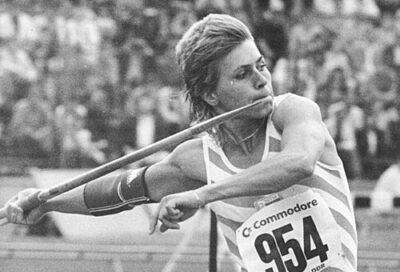
Petra Felke is a German athletics competitor, b. 1959. Born July 30, 1959, in Saalfeld. Awards include Patriotic Order of Merit in Gold.
Facts
10 facts · 1 confirmed by two sources · 5 cited · 4 from one source
Where this comes from
Papalocal keeps its own record. It started from these sources; what each one said is kept here as it was copied, so a change on their side never changes this page by itself. Tap one to read its version.
What Wikidata says · copied November 16, 2026 · revision 2568965261
- Described as
- German athletics competitor, b. 1959
- Other names
- Petra Felke-Meier, Petra Meier
- Born
- July 30, 1959 · 2 references
- Born in
- Saalfeld · 1 reference
- Citizen of
- East Germany (–1990); Germany (1990–)
- Occupation
- athletics competitor · 1 reference; javelin thrower
- Sport
- athletics · 2 references
- Awards
- Patriotic Order of Merit in Gold
- Children
- Tom Meier · 1 reference
- Height
- 1.72 m (5 ft 8 in) · 1 reference
- Wikipedias with a page
- 29
Wikidata item Q73946 (wikidata.org/wiki/Q73946), public domain (CC0). Copied November 16, 2026.
What Wikipedia says · copied November 16, 2026 · revision 1364583999
Petra Meier (née Felke; born 30 July 1959) is a retired German track and field athlete who competed in the javelin throw. Representing East Germany, she became the Olympic Champion in 1988 and broke the world record four times between 1985 and 1988. She is the only woman to throw a javelin 80 metres or more, with her world record of 80.00 m (262 ft 5 1⁄2 in). This throw was the world record from 1988 until 1999, when a new javelin design was implemented. She also won the javelin title at the 1989 IAAF World Cup and silver medals at the World Championships in 1987 and 1991.
- Born, in its opening lines
- July 30, 1959
From the Wikipedia article “Petra Felke” (en.wikipedia.org/wiki/Petra_Felke), by its contributors, under CC BY-SA 4.0 (creativecommons.org/licenses/by-sa/4.0/). Copied November 16, 2026; not changed.
Confirmed Two sources agree. Cited One source, and it names where it got it. One source One source, without a reference of its own. Sources disagree The sources disagree. We show the best-supported value and keep theirs below.
