
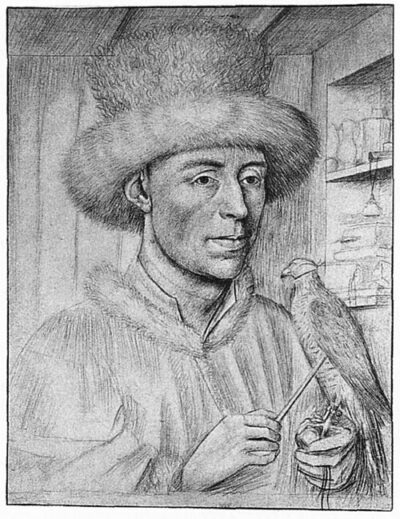
Petrus Christus
Petrus Christus was a Flemish painter (c.1410-1475). Born 1410, in Baarle. Died September 2, 1475, in Bruges. Known for A Goldsmith in His Shop, Portrait of a Young Girl and Isabella of Portugal with Saint Elisabeth.
Facts
11 facts · 0 confirmed by two sources · 7 cited · 3 from one source · 1 where the sources disagree
What’s different
- Born: we show 1410 (Sources disagree). Wikidata also lists 1425 and 1415
Where this comes from
Papalocal keeps its own record. It started from these sources; what each one said is kept here as it was copied, so a change on their side never changes this page by itself. Tap one to read its version.
What Wikidata says · copied November 16, 2026 · revision 2569305380
- Described as
- Flemish painter (c.1410-1475)
- Other names
- Pierre Cristus, Petrus Cristus, Petrus Christus (I), Peter Christus, Peter Christus (I), Peter Cristus, Peter Cristus (I), Petrus Cristus (I), p. christus, Christus, Petrus Cristus the Elder, Petrus Christus o Cristus
- Born
- 1410 · 2 references; 1425 · 1 reference; 1415 · 1 reference
- Died
- September 2, 1475 · 1 reference
- Born in
- Baarle · 1 reference
- Died in
- Bruges · 1 reference
- Citizen of
- Southern Netherlands · 1 reference
- Occupation
- painter · 3 references; illuminator · 1 reference
- Known for
- A Goldsmith in His Shop; Portrait of a Young Girl; Isabella of Portugal with Saint Elisabeth
- Field
- Dutch painting · 1 reference
- Wikipedias with a page
- 38
Wikidata item Q312616 (wikidata.org/wiki/Q312616), public domain (CC0). Copied November 16, 2026.
What Wikipedia says · copied November 16, 2026 · revision 1384682999
Petrus Christus (Dutch: [ˈpeːtrʏs ˈkrɪstʏs, ˈxrɪs-]; c. 1410/1420 – c. 1475/1476) was an Early Netherlandish painter active in Bruges from 1444, where, along with Hans Memling, he became the leading painter after the death of Jan van Eyck. He was influenced by van Eyck and Rogier van der Weyden and is noted for his innovations with linear perspective and a meticulous technique which seems derived from miniatures and manuscript illumination. Today, some 30 works are confidently attributed to him. The best known include the Portrait of a Carthusian (1446) and Portrait of a Young Girl (c. 1470); both are highly innovative in the presentation of the figure against detailed, rather than flat, backgrounds.
For the period between the death of Jan van Eyck in 1441 and Hans Memling's establishment in the city in the mid-1460s, Christus was the leading painter in Bruges, which was then the leading Netherlandish centre of painting.
Christus was an anonymous figure for centuries, his importance not established until the work of modern art historians. Giorgio Vasari barely mentions him in his biographies of painters, written in the Renaissance, and near-contemporary records merely list him amongst many others. In the early to mid-nineteenth century, Gustav Waagen (who identified him French-style as "Pierre Christophsen") and Johann David Passavant were important in establishing Christus's biographical details and in attributing works to him.
From the Wikipedia article “Petrus Christus” (en.wikipedia.org/wiki/Petrus_Christus), by its contributors, under CC BY-SA 4.0 (creativecommons.org/licenses/by-sa/4.0/). Copied November 16, 2026; not changed.
Confirmed Two sources agree. Cited One source, and it names where it got it. One source One source, without a reference of its own. Sources disagree The sources disagree. We show the best-supported value and keep theirs below.
