
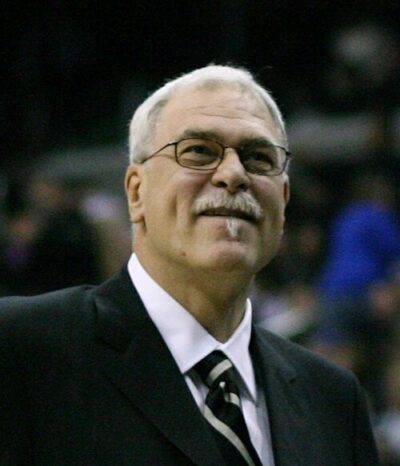
Phil Jackson
Phil Jackson is an American basketball player, coach and executive. Born September 17, 1945, in Deer Lodge. Teams include Brooklyn Nets, New York Knicks and Los Angeles Lakers. Educated at University of North Dakota and Williston High School. Awards include NBA All-Rookie Team, NBA Coach of the Year Award and Best Coach/Manager ESPY Award (3 times).
Facts
24 facts · 1 confirmed by two sources · 6 cited · 17 from one source
Where this comes from
Papalocal keeps its own record. It started from these sources; what each one said is kept here as it was copied, so a change on their side never changes this page by itself. Tap one to read its version.
What Wikidata says · copied November 13, 2026 · revision 2539208090
- Described as
- American basketball player, coach and executive
- Other names
- Philip Douglas Jackson, Action Jackson, The Zen Master, PJ
- Born
- September 17, 1945 · 3 references
- Born in
- Deer Lodge
- Citizen of
- United States · 1 reference
- Occupation
- basketball player · 1 reference; basketball coach · 1 reference; coach; basketball · 1 reference
- Education
- University of North Dakota; Williston High School · 1 reference; University of North Dakota College of Arts and Sciences
- Teams
- Brooklyn Nets; New York Knicks; Los Angeles Lakers; Chicago Bulls
- Sport
- basketball · 1 reference
- Awards
- NBA All-Rookie Team (1968); NBA Coach of the Year Award (1996); Best Coach/Manager ESPY Award (3 times) (2002, 2009, 2010)
- Field
- basketball · 1 reference
- Religion
- Buddhism
- Lived in
- North Dakota; Montana; Deer Lodge
- Height
- 2.03 m (6 ft 8 in)
- Wikipedias with a page
- 47
Wikidata item Q316246 (wikidata.org/wiki/Q316246), public domain (CC0). Copied November 13, 2026.
What Wikipedia says · copied November 13, 2026 · revision 1381247112
Philip Douglas Jackson (born September 17, 1945) is an American former professional basketball player, coach, and executive in the National Basketball Association (NBA). Jackson is a 13-time NBA champion, having won two as a player and eleven as a head coach. His eleven championships as a head coach are the most in NBA history. In 2007, Jackson was inducted into the Basketball Hall of Fame, and was named one of the ten greatest coaches in league history in 1996. He holds numerous other records as a coach, including the most postseason wins (229), and most conference titles (13).
Jackson played college basketball for the North Dakota Fighting Sioux (now known as the Fighting Hawks) for three years. He was selected in the 1967 NBA draft by the New York Knicks, with whom he won two NBA titles as a player. After playing thirteen seasons in the league, he began coaching in minor basketball leagues for five years before he was hired as the assistant coach for the Chicago Bulls in 1987.
Jackson was later promoted to head coach of the Bulls in 1989, and he helped the team win six championships (1991–1993, 1996–1998). In 1999, Jackson was hired as a head coach of the Los Angeles Lakers, and he coached the team to three consecutive titles from 2000 to 2002. Following the Lakers' loss to the Detroit Pistons in the 2004 NBA Finals, he took a season off from coaching and returned to the Lakers in 2005, winning two more championships (2009, 2010) before his retirement in 2011. He later was team president of the New York Knicks, where he began his playing career, from 2014 to 2017.
Jackson is known for his use of Tex Winter's triangle offense as well as a holistic approach to coaching that was influenced by Eastern philosophy, garnering him the nickname "Zen Master". Jackson cited Robert Pirsig's book Zen and the Art of Motorcycle Maintenance as one of the major guiding forces in his life. He also applied Native American spiritual practices as documented in his book Sacred Hoops. He is the author of several candid books about his teams and his basketball strategies.
- Born, in its opening lines
- September 17, 1945
From the Wikipedia article “Phil Jackson” (en.wikipedia.org/wiki/Phil_Jackson), by its contributors, under CC BY-SA 4.0 (creativecommons.org/licenses/by-sa/4.0/). Copied November 13, 2026; not changed.
Confirmed Two sources agree. Cited One source, and it names where it got it. One source One source, without a reference of its own. Sources disagree The sources disagree. We show the best-supported value and keep theirs below.
