
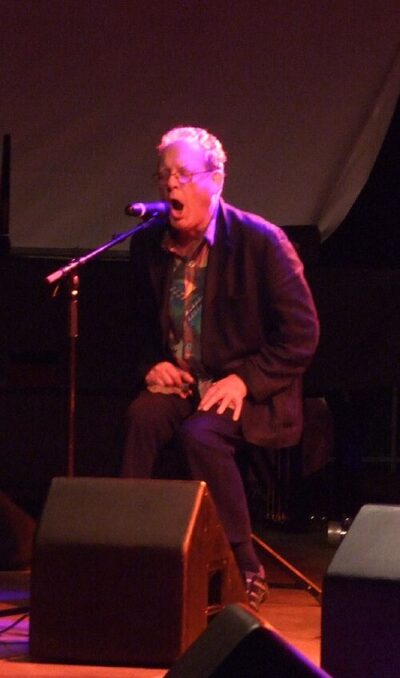
Phil Minton
Phil Minton, born November 2, 1940, is a British musician known for his work in jazz and free improvisation. He is recognized as both a vocalist and a trumpeter, contributing to the contemporary experimental music scene. Minton's career spans performance, composition, and a distinctive approach to vocal and instrumental improvisation. His contributions place him as a significant figure within the United Kingdom's avant-garde music landscape.
Facts
15 facts · 1 confirmed by two sources · 4 cited · 10 from one source
Where this comes from
Papalocal keeps its own record. It started from these sources; what each one said is kept here as it was copied, so a change on their side never changes this page by itself. Tap one to read its version.
What Wikidata says · copied November 13, 2026 · revision 2561452982
- Described as
- British jazz/free-improvising vocalist and trumpeter (born 1940)
- Born
- November 2, 1940 · 2 references
- Born in
- Torquay
- Citizen of
- United Kingdom
- Occupation
- singer; trumpeter; jazz musician · 2 references; performing artist; composer · 1 reference; musician · 1 reference
- Genre
- jazz; free jazz · 1 reference
- Instrument
- trumpet; voice
- Record label
- Emanem Records
- Website
- http://www.philminton.co.uk/
- Wikipedias with a page
- 8
Wikidata item Q2085688 (wikidata.org/wiki/Q2085688), public domain (CC0). Copied November 13, 2026.
What Wikipedia says · copied November 13, 2026 · revision 1372500604
Phil Minton (born 2 November 1940) is a British avant-garde jazz/free-improvising vocalist and trumpeter.
Minton is a highly dramatic baritone who tends to specialize in literary texts: he has sung lyrics by William Blake with Mike Westbrook's group, Daniil Kharms and Joseph Brodsky with Simon Nabatov, and extracts from James Joyce's Finnegans Wake with his own ensemble. He sings on a Jimi Hendrix tribute album, belting out the lyrics in over-the-top fashion. Between 1987 and 1993 Minton toured Europe, North America, and Russia with Lindsay Cooper's Oh Moscow ensemble.
He is perhaps best known, however, for his completely free-form work, which involves "extended techniques" that can be as unsettling as they can be mesmerising. His vocals often include the sounds of retching, burping, screaming, and gasping, as well as childlike muttering, whining, crying and humming; he also has an ability to distort his vocal cords to produce two notes at once. As the DJ/poet Kenneth Goldsmith has described it,Minton's range on this disc (A Doughnut in One Hand) runs from the sounds of a man choking on his own vomit to the sounds that grandpa makes when you finally decide to pull the plug on his respirator. Minton's like a little kid who's contact-miked himself playing yo-yo with his saliva; he's a baby drooling through his cries; he's mastered the art of the multiple burp; he's perfected the craft of goobering all over his finger and then running it over his lips while moaning. I'd hate to see what his mic looked like after he was done with it. ... Minton ... forces us to ponder the musical qualities of noises that we'd rather not deal with and for that fact alone, makes this an important recording.
Minton has worked with most of the improvising musicians in the European scene, but his most frequent improvising companions are the pianist Veryan Weston and the percussionist Roger Turner; Minton and Turner perform as a duo in the 1993 opera Agamemnon.
Minton also sang in the soundtrack to the 2025 film The Testament of Ann Lee, alongside Josephine Foster, Shelley Hirsch, Maggie Nicols, Alan Sparhawk, and others.
- Born, in its opening lines
- November 2, 1940
From the Wikipedia article “Phil Minton” (en.wikipedia.org/wiki/Phil_Minton), by its contributors, under CC BY-SA 4.0 (creativecommons.org/licenses/by-sa/4.0/). Copied November 13, 2026; not changed.
Confirmed Two sources agree. Cited One source, and it names where it got it. One source One source, without a reference of its own. Sources disagree The sources disagree. We show the best-supported value and keep theirs below.
