
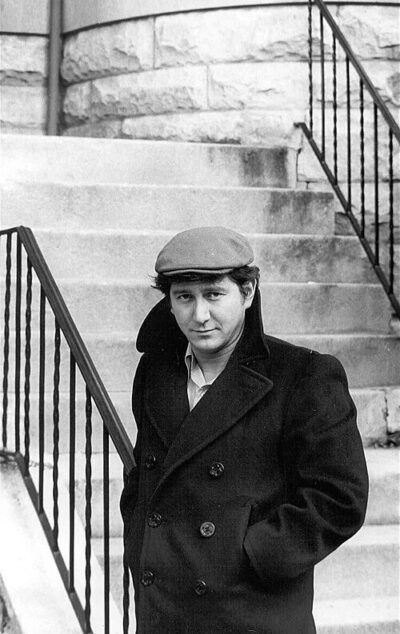
Phil Ochs
Phil Ochs was an American protest singer and songwriter. Born December 19, 1940, in El Paso. Died April 9, 1976, in Far Rockaway. Known for I Ain't Marching Anymore and I Ain't Marching Anymore. Educated at Ohio State University and Staunton Military Academy.
Facts
29 facts · 2 confirmed by two sources · 6 cited · 21 from one source
Where this comes from
Papalocal keeps its own record. It started from these sources; what each one said is kept here as it was copied, so a change on their side never changes this page by itself. Tap one to read its version.
What Wikidata says · copied November 15, 2026 · revision 2569467946
- Described as
- American protest singer and songwriter (1940-1976)
- Other names
- Philip David Ochs
- Born
- December 19, 1940 · 6 references
- Died
- April 9, 1976 · 3 references
- Born in
- El Paso · 1 reference
- Died in
- Far Rockaway
- Cause of death
- hanging to death · 1 reference
- Name at birth
- Philip David Ochs
- Citizen of
- United States
- Occupation
- singer-songwriter; singer · 1 reference; songwriter; guitarist; poet · 1 reference; musician · 1 reference; Liedermacher · 1 reference
- Education
- Ohio State University; Staunton Military Academy (1956–1958)
- Genre
- folk music; protest song; folk rock; singer-songwriter music; baroque pop
- Instrument
- guitar; voice; clarinet
- Record label
- Elektra; A&M Records (1967–)
- Known for
- I Ain't Marching Anymore · 1 reference; I Ain't Marching Anymore · 1 reference
- Website
- http://web.cecs.pdx.edu/~trent/ochs/
- Wikipedias with a page
- 36
Wikidata item Q379802 (wikidata.org/wiki/Q379802), public domain (CC0). Copied November 15, 2026.
What Wikipedia says · copied November 15, 2026 · revision 1384118233
Philip David Ochs (; December 19, 1940 – April 9, 1976) was an American singer-songwriter and political activist. Having risen to prominence as a protest singer (or, as he preferred, "topical singer") in the Greenwich Village folk revival scene of the early 1960s, Ochs' songwriting often addressed political and philosophical themes. His "There but for Fortune" became a chart hit when covered by Joan Baez in 1965, and Ochs' signature song, "I Ain't Marching Anymore", was an anthem for the anti-war movement.
After three albums consisting mostly of folk protest material, he explored baroque and art pop on Pleasures of the Harbor (1967), which contained the popular single "Outside of a Small Circle of Friends". His later albums, with genres ranging from folk rock to country music, mused on subjects both political and introspective.
Ochs performed at many political events, including protests at the 1968 Democratic National Convention, mass demonstrations sponsored by the National Mobilization Committee to End the War in Vietnam, civil rights rallies, student events, and organized labor events. He helped found the Youth International Party (YIP), commonly known as the Yippies. Ochs initially described himself as a democratic socialist but grew more radical after bearing witness to the police riots at the 1968 Democratic National Convention.
Ochs' mental stability declined in the late 1960s and 1970s as he struggled with bipolar disorder, alcoholism, and a series of traumatic events. On a 1973 trip to Tanzania, Ochs became the victim of a strangling attempt which permanently damaged his vocal chords. That same year, his friend Víctor Jara was murdered in the Chilean coup d'état. In 1975, Ochs experienced a psychotic manic episode which left him in a state of remorse and embarrassment. He died by suicide at the age of 35 on April 9, 1976.
Ochs' best-known songs include "When I'm Gone", "Changes", "Crucifixion", "Draft Dodger Rag", "Love Me, I'm a Liberal", "Power and the Glory", and "The War Is Over".
- Born, in its opening lines
- December 19, 1940
- Died, in its opening lines
- April 9, 1976
From the Wikipedia article “Phil Ochs” (en.wikipedia.org/wiki/Phil_Ochs), by its contributors, under CC BY-SA 4.0 (creativecommons.org/licenses/by-sa/4.0/). Copied November 15, 2026; not changed.
Confirmed Two sources agree. Cited One source, and it names where it got it. One source One source, without a reference of its own. Sources disagree The sources disagree. We show the best-supported value and keep theirs below.
