
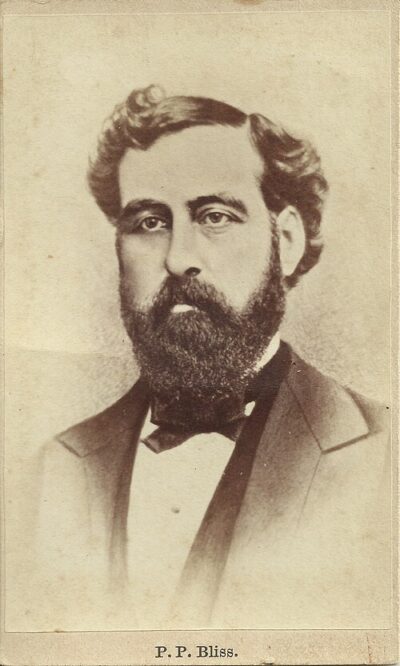
Philip Bliss
Philip Bliss was the 19th century Christian hymnodist. Born July 9, 1838, in Clearfield County. Died December 29, 1876, in Ashtabula. Known for Now.
Facts
16 facts · 2 confirmed by two sources · 11 cited · 3 from one source
Where this comes from
Papalocal keeps its own record. It started from these sources; what each one said is kept here as it was copied, so a change on their side never changes this page by itself. Tap one to read its version.
What Wikidata says · copied November 18, 2026 · revision 2567605501
- Described as
- 19th century Christian hymnodist (1838–1876)
- Other names
- Philip Paul Bliss, P. P. Bliss
- Born
- July 9, 1838 · 7 references
- Died
- December 29, 1876 · 6 references
- Born in
- Clearfield County · 2 references
- Died in
- Ashtabula · 1 reference
- Buried in
- Chestnut Grove Cemetery · 1 reference
- Cause of death
- railway accident by collision · 1 reference
- Citizen of
- United States
- Occupation
- composer · 2 references; hymnwriter · 1 reference; singer · 2 references; singer-songwriter · 1 reference
- Genre
- gospel music · 1 reference
- Known for
- Now
- Religion
- Baptists · 1 reference; Presbyterianism · 1 reference
- Lived in
- Chicago · 1 reference
- Wikipedias with a page
- 16
Wikidata item Q898625 (wikidata.org/wiki/Q898625), public domain (CC0). Copied November 18, 2026.
What Wikipedia says · copied November 18, 2026 · revision 1386365801
Philip Paul Bliss (July 9, 1838 – December 29, 1876) was an American composer of gospel songs, baritone-bass singer, and song leader who collaborated with Daniel W. Whittle in evangelistic ministry; he was also a good friend of Dwight L. Moody. Some of his better-known songs are "Hold the Fort" (1870), "Almost Persuaded" (1871); "Let the Lower Lights Be Burning" (1871); "Hallelujah, What a Saviour!" (1875); "Wonderful Words of Life" (1875), and "I Will Sing of My Redeemer" (1876); he also wrote the melody for Horatio Spafford's "It Is Well with My Soul" (1876).
With a surname derived from a Middle English word meaning "joy" or "gladness, those who knew him well, like George F. Root, a close friend and one-time employer, would say of him, "His smile went into his religion and his religion into his smile", while Arthur T. Pierson, successor to Charles H. Spurgeon at the Metropolitan Tabernacle of London, testified that "he was well named 'Bliss'. What a happy man he was! What a ray of sunshine, what a spring of joy!"
- Born, in its opening lines
- July 9, 1838
- Died, in its opening lines
- December 29, 1876
From the Wikipedia article “Philip Bliss” (en.wikipedia.org/wiki/Philip_Bliss), by its contributors, under CC BY-SA 4.0 (creativecommons.org/licenses/by-sa/4.0/). Copied November 18, 2026; not changed.
Confirmed Two sources agree. Cited One source, and it names where it got it. One source One source, without a reference of its own. Sources disagree The sources disagree. We show the best-supported value and keep theirs below.
