
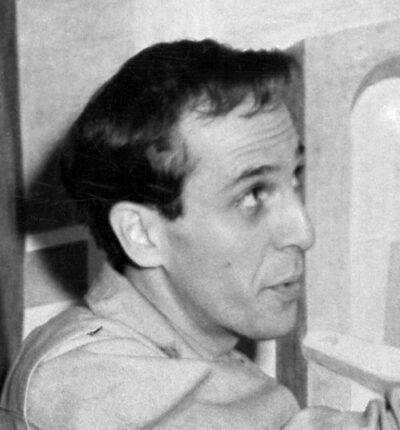
Philip Guston
Philip Guston was an American artist. Born June 27, 1913, in Montreal. Died June 7, 1980, in Woodstock. Known for Late Afternoon. Educated at Otis College of Art and Design and Manual Arts High School. Awards include Guggenheim Fellowship and Rome Prize.
Facts
30 facts · 2 confirmed by two sources · 14 cited · 14 from one source
Where this comes from
Papalocal keeps its own record. It started from these sources; what each one said is kept here as it was copied, so a change on their side never changes this page by itself. Tap one to read its version.
What Wikidata says · copied November 15, 2026 · revision 2569328872
- Described as
- American artist (1913-1980)
- Other names
- Philip Goldstein, Phillip Goldstein
- Born
- June 27, 1913 · 12 references
- Died
- June 7, 1980 · 12 references
- Born in
- Montreal · 2 references
- Died in
- Woodstock · 1 reference
- Buried in
- Woodstock Artists Cemetery · 1 reference
- Cause of death
- myocardial infarction
- Citizen of
- United States · 1 reference; Canada · 1 reference
- Occupation
- painter · 2 references; illustrator · 1 reference; muralist · 1 reference; lithographer · 1 reference; engraver · 1 reference; draftsperson · 1 reference; printmaker · 1 reference; architectural drafter · 1 reference
- Worked for
- Washington University in St. Louis; Works Progress Administration; University of Iowa (1941–1945)
- Education
- Otis College of Art and Design; Manual Arts High School · 1 reference
- Member of
- American Academy of Arts and Letters
- Genre
- abstract art; figurative art · 1 reference
- Known for
- Late Afternoon
- Awards
- Guggenheim Fellowship · 1 reference; Rome Prize (1971)
- Field
- painting · 1 reference
- Spouse
- Musa Guston · 1 reference; Musa McKim
- Wikipedias with a page
- 26
Wikidata item Q701952 (wikidata.org/wiki/Q701952), public domain (CC0). Copied November 15, 2026.
What Wikipedia says · copied November 15, 2026 · revision 1380927932
Philip Guston (born Phillip Goldstein, June 27, 1913 – June 7, 1980) was a Canadian and American painter, printmaker, muralist and draftsman. "Guston worked in a number of artistic modes, from Renaissance-inspired figuration to formally accomplished abstraction," and is now regarded as one of the "most important, powerful, and influential American painters of the last 100 years". He frequently depicted racism, antisemitism, fascism and American identity, as well as—especially in his later most cartoonish and mocking work—the banality of evil. In 2013, Guston's painting To Fellini set an auction record at Christie's when it sold for US$25.8 million.
Guston was a founding figure in the mid-century New York School, which established New York as the new center of the global art world, and his work appeared in the famed Ninth Street Show and in the avant-garde art journal It is. A Magazine for Abstract Art. By the 1960s, Guston had renounced abstract expressionism and was helping pioneer a modified form of representational art known as neo-expressionism. "Calling American abstract art 'a lie' and 'a sham,' he pivoted to making paintings in a dark, figurative style, including satirical drawings of Richard Nixon" during the Vietnam War as well as several paintings of hooded Klansmen, which Guston explained this way: "They are self-portraits ... I perceive myself as being behind the hood ... The idea of evil fascinated me ... I almost tried to imagine that I was living with the Klan." The paintings of Klan figures were set to be part of an international retrospective sponsored by the National Gallery of Art, the Tate Modern, the Museum of Fine Arts, Houston, and the Museum of Fine Arts, Boston in 2020, but in late September, the museums jointly postponed the exhibition until 2024, "a time at which we think that the powerful message of social and racial justice that is at the center of Philip Guston's work can be more clearly interpreted."
The announcement spurred an open letter, published online by The Brooklyn Rail and signed by more than 2,000 artists. It criticizes the postponement and the museums' lack of courage to display or attempt to interpret Guston's work, as well as the museums' own "history of prejudice". It calls Guston's KKK themes a timely catalyst for a "reckoning" with cultural and institutional white supremacy, and argues that that is why the exhibition must proceed without delay. On October 28, 2020, the museums announced earlier exhibition dates starting in 2022.
- Born, in its opening lines
- June 27, 1913
- Died, in its opening lines
- June 7, 1980
From the Wikipedia article “Philip Guston” (en.wikipedia.org/wiki/Philip_Guston), by its contributors, under CC BY-SA 4.0 (creativecommons.org/licenses/by-sa/4.0/). Copied November 15, 2026; not changed.
Confirmed Two sources agree. Cited One source, and it names where it got it. One source One source, without a reference of its own. Sources disagree The sources disagree. We show the best-supported value and keep theirs below.
