
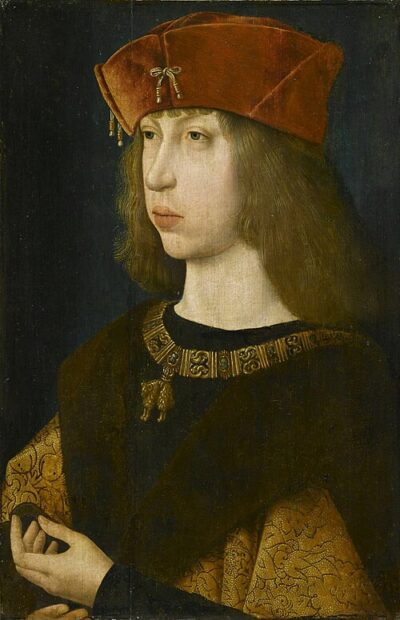
Philip I of Castile
Philip I of Castile was a King of Castile (1506), Ruler of Habsburg Netherlands. Born June 22, 1478, in Bruges. Died September 25, 1506, in Burgos. Positions held include King of Castile and León (Iure uxoris) (1504–1506). Awards include Knight of the Order of the Golden Fleece and Knight of the Garter.
Facts
29 facts · 2 confirmed by two sources · 11 cited · 16 from one source
Where this comes from
Papalocal keeps its own record. It started from these sources; what each one said is kept here as it was copied, so a change on their side never changes this page by itself. Tap one to read its version.
What Wikidata says · copied November 16, 2026 · revision 2569840185
- Described as
- King of Castile (1506), Ruler of Habsburg Netherlands (1482-1506)
- Other names
- Philip the Handsome, Philip the Fair, Philip IV of Burgundy, Philip I of Spain
- Born
- June 22, 1478 · 1 reference
- Died
- September 25, 1506 · 3 references
- Born in
- Bruges · 2 references
- Died in
- Burgos · 2 references
- Buried in
- Royal Chapel of Granada · 1 reference
- Cause of death
- pneumonia
- Citizen of
- Kingdom of Castile
- Occupation
- ruler
- Positions held
- King of Castile and León (Iure uxoris) (1504–1506)
- Sport
- hand-pelota; Castilian bar launch
- Awards
- Knight of the Order of the Golden Fleece; Knight of the Garter (1503) · 1 reference
- Spouse
- Juana I of Castile (1496–1506) · 2 references
- Children
- Eleanor of Austria · 1 reference; Charles V, Holy Roman Emperor · 1 reference; Isabella of Austria; Ferdinand I, Holy Roman Emperor · 1 reference; Mary of Hungary; Catherine of Austria, Queen of Portugal · 1 reference; Rietje Koane
- Father
- Maximilian I · 1 reference
- Mother
- Mary of Burgundy · 1 reference
- Siblings
- Margaret of Austria, Duchess of Savoy · 1 reference; George of Austria; Cornelius of Austria; Francis of Habsburg; Leopoldo de Austria
- Religion
- Roman Catholic
- Wikipedias with a page
- 59
Wikidata item Q157098 (wikidata.org/wiki/Q157098), public domain (CC0). Copied November 16, 2026.
What Wikipedia says · copied November 16, 2026 · revision 1383391138
Philip the Handsome (22 June/July 1478 – 25 September 1506), also called Philip the Fair, was ruler of the Habsburg Netherlands from 1482, including the counties of Artois, Burgundy and Charolais from 1493, and the first king of Castile from the House of Habsburg in 1506.
Philip was the son of Maximilian I of Austria and Mary of Burgundy. Maximilian was a prince of the House of Habsburg who became Holy Roman emperor. Mary was the daughter of Charles the Bold and heiress of the wealthy and extensive complex of domains that made up Valois Burgundy, including the Burgundian Netherlands. In 1482, at the age of three, Philip's mother died and he inherited her titles and domains. As a result, he became the first Habsburg ruler of the Netherlands. Although his inheritance was, in part, challenged by the French king Louis XI, it was largely confirmed by the Treaty of Arras (1482) and the Treaty of Senlis (1493). Despite his young age, Philip quickly proved himself an effective ruler beloved by his people in the Low Countries, pursuing policies that favored peace and economic development, while maintaining a steady course of the government building.
In 1496, Philip's father arranged for him to marry Joanna, the second daughter of Queen Isabella I of Castile and King Ferdinand II of Aragon. Around the same time, Philip's sister, Margaret, was given in marriage to Joanna's brother John, Prince of Asturias. After the deaths of her brother John, sister Isabella, and nephew Miguel, Joanna became heir presumptive to the thrones of Castile and Aragon. Most of Philip's time in Spain was spent consolidating his power, often leading to conflicts with his wife and her father. Joanna became queen of Castile when her mother died in 1504. Philip was proclaimed king in 1506, but died a few months later, leaving his wife distraught with grief. Joanna's father, Ferdinand II of Aragon, and son, Charles, were quick to seize power, confining the queen for the rest of her life on account of her alleged insanity.
Philip died before his father, and therefore never inherited his father's territories or became emperor. However, his son Charles eventually united the Habsburg, Burgundian, Castilian, and Aragonese inheritances. By inheriting the Burgundian Netherlands and acquiring much of Spain and its possessions in the New World by marriage to Joanna, Philip was instrumental in greatly enhancing the territories of the Habsburgs, and his progeny would rule over vast European territories for the next five centuries.
- Born, in its opening lines
- July 1478
- Died, in its opening lines
- September 25, 1506
From the Wikipedia article “Philip the Handsome” (en.wikipedia.org/wiki/Philip_the_Handsome), by its contributors, under CC BY-SA 4.0 (creativecommons.org/licenses/by-sa/4.0/). Copied November 16, 2026; not changed.
Confirmed Two sources agree. Cited One source, and it names where it got it. One source One source, without a reference of its own. Sources disagree The sources disagree. We show the best-supported value and keep theirs below.
