
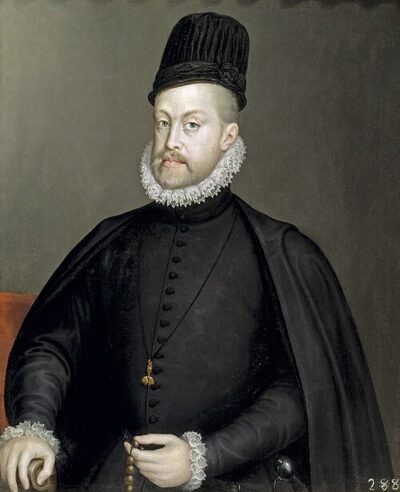
Philip II of Spain
Philip II of Spain was a King of Spain, Portugal, Naples and Sicily; King consort of England, lived 1527-1598. Born May 21, 1527, in Palacio de Pimentel. Died September 13, 1598, in Royal Monastery of San Lorenzo de El Escorial. Positions held include Monarch of Castile and Leon (1556–1598), Monarch of Portugal (1580–1598) and monarch of the Crown of Aragon (1556–1598). Awards include Knight in the Order of the Holy Sepulchre, Grand Master of the Order of the Tower and Sword and Knight of the Garter.
Facts
46 facts · 2 confirmed by two sources · 10 cited · 34 from one source
Where this comes from
Papalocal keeps its own record. It started from these sources; what each one said is kept here as it was copied, so a change on their side never changes this page by itself. Tap one to read its version.
What Wikidata says · copied November 16, 2026 · revision 2569839979
- Described as
- King of Spain, Portugal, Naples and Sicily; King consort of England, lived 1527-1598
- Other names
- Felipe II, Philip I of Portugal, Philip II
- Born
- May 21, 1527 · 3 references
- Died
- September 13, 1598 · 12 references
- Born in
- Palacio de Pimentel · 2 references
- Died in
- Royal Monastery of San Lorenzo de El Escorial · 1 reference
- Buried in
- Royal Crypt of the Royal Monastery of San Lorenzo de El Escorial
- Cause of death
- cancer
- Citizen of
- Spain; Kingdom of Portugal
- Occupation
- ruler
- Positions held
- Monarch of Castile and Leon (1556–1598); Monarch of Portugal (1580–1598); monarch of the Crown of Aragon (1556–1598); Lord of the Netherlands; King of England (jure uxoris) (1554–1558); King of Ireland (Iure uxoris) (1554–1558); monarch; King of Sardinia (1556–1598); King of Naples; King of Sicily; Grand Master of the Order of the Golden Fleece (1555–1598)
- Awards
- Knight in the Order of the Holy Sepulchre; Grand Master of the Order of the Tower and Sword; Knight of the Garter (1554) · 1 reference; Knight of the Order of the Golden Fleece (1531–1598)
- Spouse
- Maria Manuela, Princess of Portugal (1543–1545) · 2 references; Mary I (1554–1558) · 2 references; Elisabeth of Valois (1560–1568) · 2 references; Anna of Austria, Queen of Spain (1570–1580) · 2 references
- Children
- Carlos, Prince of Asturias; Isabella Clara Eugenia of Spain; Catalina Micaela of Spain; Ferdinand, Prince of Asturias; Infante Carlos Lorenzo of Spain; Diego, Prince of Asturias · 1 reference; Philip III of Spain; Infanta Maria of Spain; Pedro de Osorio
- Father
- Charles V, Holy Roman Emperor · 1 reference
- Mother
- Isabella of Portugal · 1 reference
- Siblings
- Maria of Austria, Holy Roman Empress · 1 reference; Infante Fernando of Austria; Joanna of Austria, Princess of Portugal; Isabel of Castile; Margaret of Parma; Tadea of Austria; John of Austria
- Wikipedias with a page
- 111
Wikidata item Q34417 (wikidata.org/wiki/Q34417), public domain (CC0). Copied November 16, 2026.
What Wikipedia says · copied November 16, 2026 · revision 1385923629
Philip II (21 May 1527 – 13 September 1598), sometimes known in Spain as Philip the Prudent (Spanish: Felipe el Prudente), was King of Spain from 1556, King of Portugal from 1580, and King of Naples and Sicily from 1554 until his death in 1598. He was also jure uxoris King of England and Ireland from his marriage to Queen Mary I in 1554 until her death in 1558. Further, he was Duke of Milan from 1540. From 1555, he was Lord of the Seventeen Provinces of the Netherlands.
Philip was born and raised in Spain. The son of Emperor Charles V and Isabella of Portugal, he inherited his father's Spanish Empire in 1556, and succeeded to the Portuguese throne in 1580 following a dynastic crisis, forming the Iberian Union. The Spanish conquest of the Inca Empire and of the Philippines, named in his honour by Ruy López de Villalobos, were completed during his reign. He finished building the royal palace El Escorial in 1584. Under Philip II, Spain reached the height of its influence and power, advancing into the Spanish Golden Age, and ruled territories in every continent then known to Europeans. Deeply devout, Philip saw himself as the defender of Catholic Europe against the Ottoman Empire and the Protestant Reformation, and invested Spain's position as the leading European power in multiple simultaneous warring efforts.
During his reign, Spain participated in notable victories against the Ottomans in Oran, Malta and Lepanto. In 1584, during the Eighty Years' War, Philip signed the Treaty of Joinville, funding the French Catholic League over the following decade against the French Huguenots. In 1588, he sent an armada to invade Protestant England, with the strategic aim of overthrowing his former sister-in-law Elizabeth I and re-establishing Catholicism there, but his fleet was repulsed in a skirmish and wrecked by storms as it returned to Spain. He sent additional Armadas in 1596 and 1597, (and his son who succeeded him as Phillip III sent a fourth in 1601), but these similarly failed. Philip's naval power recovered after the defeat of a similarly sized English Armada sent against Spain. As a consequence of these conflicts, Philip led a highly debt-leveraged regime, seeing state defaults in 1557, 1560, 1569, 1575, and 1596. An ambitious plan to extend his conquests to China and across Asia was also considered and abandoned.
Historical reception of Philip II became heavily influenced by enemy propaganda, which he refused to answer or defend himself against, even prohibiting biographical accounts of his life. His negative foreign reputation eventually developed into the Spanish Black Legend. As a result, historian Helmut Koenigsberger would write about Philip, "there has, perhaps, been no personality in modern history, not even Napoleon or Stalin, who has been both as enigmatic and controversial as Philip II of Spain... Neither his own contemporaries nor later historians have been able to agree on his character, his aims or even the degree of success he achieved."
- Born, in its opening lines
- May 21, 1527
- Died, in its opening lines
- September 13, 1598
From the Wikipedia article “Philip II of Spain” (en.wikipedia.org/wiki/Philip_II_of_Spain), by its contributors, under CC BY-SA 4.0 (creativecommons.org/licenses/by-sa/4.0/). Copied November 16, 2026; not changed.
Confirmed Two sources agree. Cited One source, and it names where it got it. One source One source, without a reference of its own. Sources disagree The sources disagree. We show the best-supported value and keep theirs below.
