
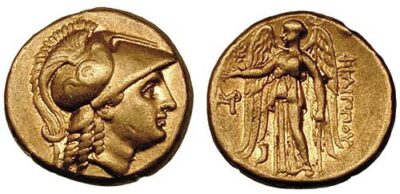
Philip III of Macedon
Philip III of Macedon was a king of Macedonia. Born 359 BC. Died October 317 BC, in Macedonia. Positions held include king of Macedonia (-323–-317).
Facts
17 facts · 0 confirmed by two sources · 1 cited · 16 from one source
Where this comes from
Papalocal keeps its own record. It started from these sources; what each one said is kept here as it was copied, so a change on their side never changes this page by itself. Tap one to read its version.
What Wikidata says · copied November 16, 2026 · revision 2561374223
- Described as
- king of Macedonia
- Other names
- Arrhidaios, Arridaios, Philippos Arrhidaios, Philip Arrhidaeus
- Born
- 359 BC
- Died
- October 317 BC · 1 reference
- Died in
- Macedonia · 1 reference
- Buried in
- Macedonian royal tombs, Vergina
- Citizen of
- Macedonia
- Occupation
- politician
- Positions held
- king of Macedonia (-323–-317)
- Spouse
- Eurydice II of Macedon · 1 reference
- Father
- Philip II of Macedon · 1 reference
- Mother
- Philinna · 1 reference
- Siblings
- Alexander the Great; Cleopatra of Macedon; Cynane; Thessalonike of Macedon; Europa of Macedon; Caranus
- Religion
- Ancient Greek religion · 1 reference
- Wikipedias with a page
- 48
Wikidata item Q295530 (wikidata.org/wiki/Q295530), public domain (CC0). Copied November 16, 2026.
What Wikipedia says · copied November 16, 2026 · revision 1385316344
Philip III Arrhidaeus (Ancient Greek: Φίλιππος Ἀρριδαῖος, romanized: Phílippos Arrhidaîos; c. 357 BC – 317 BC) was king of the ancient Greek kingdom of Macedonia from 323 until his execution in 317 BC. He was a son of King Philip II of Macedon by Philinna of Larissa, and thus an elder half-brother of Alexander the Great. Named Arrhidaeus at birth, he assumed the name Philip when he ascended to the throne.
The ancient sources describe Arrhidaeus as having some kind of intellectual impairment, although historians have noted that the Ancient Greeks viewed deafness and muteness as an intellectual disability, and therefore we cannot rule out that Arrhidaeus was not physically disabled. Plutarch was of the view that he became disabled by means of an attempt on his life by Philip II's wife, Queen Olympias, who wanted to eliminate a possible rival to her son, Alexander, through the employment of pharmaka (drugs/spells); however, most modern authorities doubt the truth of this claim.
Alexander was fond of Arrhidaeus and took him on his campaigns, both to protect his life and to prevent his use as a pawn in any prospective challenge for the throne. After Alexander's death in Babylon in 323 BC, the Macedonian army in Asia proclaimed Arrhidaeus as king; however, he served merely as a figurehead and as the pawn of a series of powerful generals.
From the Wikipedia article “Philip III of Macedon” (en.wikipedia.org/wiki/Philip_III_of_Macedon), by its contributors, under CC BY-SA 4.0 (creativecommons.org/licenses/by-sa/4.0/). Copied November 16, 2026; not changed.
Confirmed Two sources agree. Cited One source, and it names where it got it. One source One source, without a reference of its own. Sources disagree The sources disagree. We show the best-supported value and keep theirs below.
