
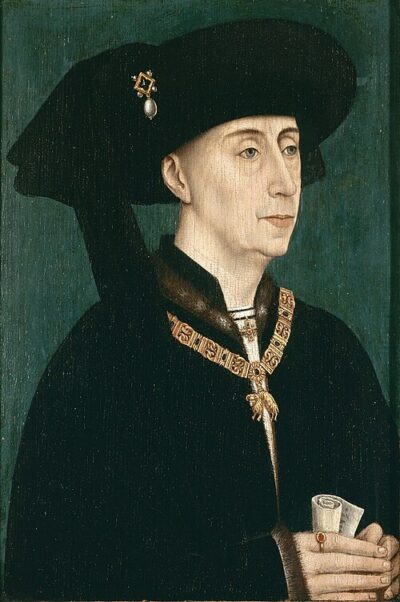
Philip III the Good
Philip III the Good was a Duke of Burgundy from 1419 to 1467. Born July 31, 1396, in Dijon. Died June 15, 1467, in Bruges. Positions held include monarch. Awards include Knight of the Order of the Golden Fleece.
Facts
32 facts · 2 confirmed by two sources · 14 cited · 16 from one source
Where this comes from
Papalocal keeps its own record. It started from these sources; what each one said is kept here as it was copied, so a change on their side never changes this page by itself. Tap one to read its version.
What Wikidata says · copied November 16, 2026 · revision 2569840625
- Described as
- Duke of Burgundy from 1419 to 1467 (1396-1467)
- Other names
- Philippe III, Philip III Duke of Burgundy, Philip III
- Born
- July 31, 1396 · 2 references
- Died
- June 15, 1467 · 2 references
- Born in
- Dijon · 2 references
- Died in
- Bruges · 2 references
- Buried in
- Champmol
- Citizen of
- Kingdom of France · 1 reference
- Occupation
- military personnel; politician
- Positions held
- monarch
- Member of
- Den Boeck
- Awards
- Knight of the Order of the Golden Fleece
- Spouse
- Michelle of Valois (1409–1422) · 2 references; Bonne of Artois (1424–1425) · 2 references; Isabella of Portugal, Duchess of Burgundy (1430–) · 1 reference
- Children
- Charles the Bold · 1 reference; David of Burgundy; Anthony, bastard of Burgundy · 1 reference; Philip of Burgundy; Corneille of Burgundy; Anna of Burgundy · 1 reference; Raphael de Mercatellis; Baudouin de Bourgogne; Mary of Burgundy; Cornelia of Burgundy; Jodocus of Burgundy; Catherine bâtarde de Bourgogne · 1 reference
- Father
- John the Fearless · 1 reference
- Mother
- Margaret of Bavaria · 1 reference
- Siblings
- Agnes of Burgundy · 1 reference; Marie of Burgundy · 1 reference; Margaret of Burgundy; Anne of Burgundy
- Wikipedias with a page
- 59
Wikidata item Q239337 (wikidata.org/wiki/Q239337), public domain (CC0). Copied November 16, 2026.
What Wikipedia says · copied November 16, 2026 · revision 1384171015
Philip III (31 July 1396 – 15 June 1467), also known as Philip the Good (French: Philippe le Bon; Dutch: Filips de Goede), was Duke of Burgundy from 1419 until his death in 1467. He was a member of a cadet line of the House of Valois, to which all 15th-century kings of France belonged. During his reign, the Burgundian State reached the apex of its prosperity and prestige, and became a leading centre of the arts.
Duke Philip has a reputation for his administrative reforms, for his patronage of Flemish artists (such as Jan van Eyck) and of Franco-Flemish composers (such as Binchois), and for the 1430 seizure of Joan of Arc, whom Philip ransomed to the English after his soldiers captured her, resulting in her trial and eventual execution. In political affairs, he alternated between alliances with the English and with the French in an attempt to improve his dynasty's powerbase. Additionally, as ruler of Flanders, Brabant, Limburg, Artois, Hainaut, Holland, Luxembourg, Zeeland, Friesland and Namur, he played an important role in the consolidation of Low Countries; for this Justus Lipsius called him 'Conditor Belgii'.
He married three times and had three legitimate sons, all from his third marriage; only one legitimate son reached adulthood. Philip had 24 documented mistresses and fathered at least 18 illegitimate children.
- Born, in its opening lines
- July 31, 1396
- Died, in its opening lines
- June 15, 1467
From the Wikipedia article “Philip the Good” (en.wikipedia.org/wiki/Philip_the_Good), by its contributors, under CC BY-SA 4.0 (creativecommons.org/licenses/by-sa/4.0/). Copied November 16, 2026; not changed.
Confirmed Two sources agree. Cited One source, and it names where it got it. One source One source, without a reference of its own. Sources disagree The sources disagree. We show the best-supported value and keep theirs below.
