
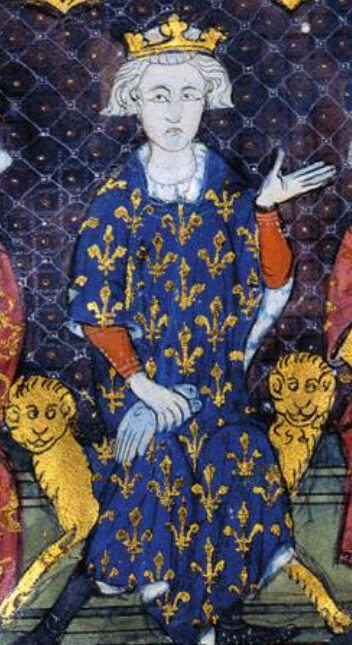
Philip IV of France
Philip IV of France was a King of France from 1285 to 1314. Born June 1268, in Fontainebleau. Died November 29, 1314, in Fontainebleau. Positions held include King of France (1285–1314) and King of Navarre (Iure uxoris) (1284–1305).
Facts
24 facts · 2 confirmed by two sources · 10 cited · 11 from one source · 1 where the sources disagree
What’s different
- Cause of death: we show stroke (Sources disagree). Wikidata also lists hunting accident
Where this comes from
Papalocal keeps its own record. It started from these sources; what each one said is kept here as it was copied, so a change on their side never changes this page by itself. Tap one to read its version.
What Wikidata says · copied November 16, 2026 · revision 2569840636
- Described as
- King of France from 1285 to 1314 (1268–1314)
- Other names
- Philip IV, Philip the Fair
- Born
- June 1268 · 18 references
- Died
- November 29, 1314 · 1 reference
- Born in
- Fontainebleau · 1 reference
- Died in
- Fontainebleau · 1 reference
- Buried in
- Basilica of Saint-Denis
- Cause of death
- stroke; hunting accident
- Citizen of
- Kingdom of France
- Occupation
- ruler
- Positions held
- King of France (1285–1314); King of Navarre (Iure uxoris) (1284–1305)
- Spouse
- Joan I of Navarre (1284–1305) · 2 references
- Children
- Louis X of France · 1 reference; Philip V of France · 1 reference; Charles IV of France · 1 reference; Isabella of France · 1 reference; Robert of France
- Father
- Philip III of France · 1 reference
- Mother
- Isabella of Aragon · 1 reference
- Siblings
- Margaret of France; Blanche of France, Duchess of Austria; Louis of France; Charles of Valois · 1 reference; Louis of Evreux
- Religion
- Christianity
- Wikipedias with a page
- 85
Wikidata item Q130969 (wikidata.org/wiki/Q130969), public domain (CC0). Copied November 16, 2026.
What Wikipedia says · copied November 16, 2026 · revision 1384508534
Philip IV (April–June 1268 – 29 November 1314), called Philip the Fair (French: Philippe le Bel), was King of France from 1285 to 1314. By virtue of his marriage with Joan I of Navarre, he was also King of Navarre and Count of Champagne as Philip I from 1284 to 1305. Although Philip was known to be handsome, hence the epithet le Bel, his rigid, autocratic, imposing, and inflexible personality gained him (from friend and foe alike) other nicknames, such as the Iron King (French: le Roi de fer). His fierce opponent Bernard Saisset, bishop of Pamiers, said of him: "He is neither man nor beast. He is a statue."
Philip, seeking to reduce the wealth and power of the nobility and clergy, relied instead on educated and skilful civil servants, such as Guillaume de Nogaret and Enguerrand de Marigny, to govern the kingdom. The king, who sought an uncontested monarchy, compelled his vassals by wars and restricted their feudal privileges, paving the way for the transformation of France from a feudal country to a centralised early modern state. Internationally, Philip's ambitions made him highly influential in European affairs, and for much of his reign, he sought to place his relatives on foreign thrones. Princes from his house ruled in Hungary and in the Kingdom of Naples, and he tried and failed to make another relative the Holy Roman Emperor.
The most notable conflicts of Philip's reign include a dispute with the English over King Edward I's duchy in southwestern France and a war with the County of Flanders, who had rebelled against French royal authority and humiliated Philip at the Battle of the Golden Spurs in 1302. The war with the Flemish resulted in Philip's ultimate victory, after which he received a significant portion of Flemish cities, which were added to the crown lands along with a vast sum of money. Domestically, his reign was marked by struggles with the Jews and the Knights Templar. In heavy debt to both groups, Philip saw them as a "state within the state" and a recurring threat to royal power. In 1306 Philip expelled the Jews from France, followed by the total destruction of the Knights Templar in 1307. To further strengthen the monarchy, Philip tried to tax and impose state control over the Catholic Church in France, leading to a violent dispute with Pope Boniface VIII. The ensuing conflict saw the pope's residence at Anagni attacked in September 1303 by French forces with the support of the Colonna family. Pope Boniface was captured and held hostage for several days. This eventually led to the Avignon Papacy of 1309 to 1376.
His final year saw a scandal amongst the royal family, known as the Tour de Nesle affair, in which King Philip's three daughters-in-law were accused of adultery. His three sons were successively kings of France: Louis X, Philip V, and Charles IV. Their rapid successive deaths without surviving sons of their own would compromise the future of the French royal house, which had until then seemed secure, precipitating a succession crisis that eventually led to the Hundred Years' War (1337–1453).
- Born, in its opening lines
- June 1268
- Died, in its opening lines
- November 29, 1314
From the Wikipedia article “Philip IV of France” (en.wikipedia.org/wiki/Philip_IV_of_France), by its contributors, under CC BY-SA 4.0 (creativecommons.org/licenses/by-sa/4.0/). Copied November 16, 2026; not changed.
Confirmed Two sources agree. Cited One source, and it names where it got it. One source One source, without a reference of its own. Sources disagree The sources disagree. We show the best-supported value and keep theirs below.
