
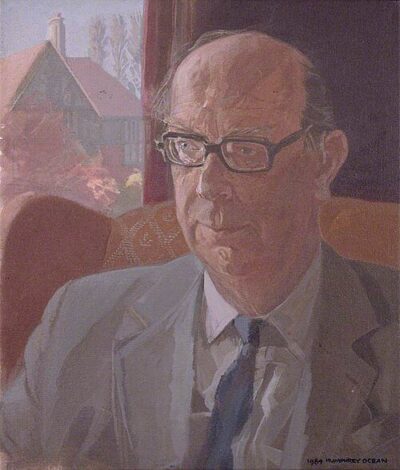
Philip Larkin
Philip Larkin was an English writer, jazz critic and librarian. Born August 9, 1922, in Coventry. Died December 2, 1985, in Kingston upon Hull. Positions held include Booker Prize judge (1977). Educated at St John's College and King Henry VIII School, Coventry. Awards include Commander of the Order of the British Empire, Cholmondeley Award and King’s / Queen’s Gold Medal for Poetry.
Facts
29 facts · 2 confirmed by two sources · 10 cited · 17 from one source
Where this comes from
Papalocal keeps its own record. It started from these sources; what each one said is kept here as it was copied, so a change on their side never changes this page by itself. Tap one to read its version.
What Wikidata says · copied November 16, 2026 · revision 2567046163
- Described as
- English writer, jazz critic and librarian (1922-1985)
- Other names
- Philip Arthur Larkin
- Born
- August 9, 1922 · 9 references
- Died
- December 2, 1985 · 9 references
- Born in
- Coventry · 2 references
- Died in
- Kingston upon Hull · 2 references
- Buried in
- Cottingham
- Cause of death
- esophageal cancer
- Citizen of
- United Kingdom
- Occupation
- poet · 2 references; librarian · 2 references; novelist; writer · 1 reference; music journalist; music critic · 2 references; critic · 1 reference; librettist · 1 reference
- Positions held
- Booker Prize judge (1977) · 1 reference
- Worked for
- University of Hull; University of Leicester
- Education
- St John's College; King Henry VIII School, Coventry
- Member of
- Royal Society of Literature; American Academy of Arts and Sciences
- Genre
- lyric poetry
- Awards
- Commander of the Order of the British Empire; Cholmondeley Award (1973) · 1 reference; King’s / Queen’s Gold Medal for Poetry; Fellow of the Royal Society of Literature; Russell Loines Award for Poetry
- Field
- jazz
- Wikipedias with a page
- 48
Wikidata item Q313758 (wikidata.org/wiki/Q313758), public domain (CC0). Copied November 16, 2026.
What Wikipedia says · copied November 16, 2026 · revision 1384594378
Philip Arthur Larkin (9 August 1922 – 2 December 1985) was an English poet, novelist, and librarian. His first book of poetry, The North Ship, was published in 1945, followed by two novels, Jill (1946) and A Girl in Winter (1947). He came to prominence in 1955 with the publication of his second collection of poems, The Less Deceived, followed by The Whitsun Weddings (1964) and High Windows (1974). He contributed to The Daily Telegraph as its jazz critic from 1961 to 1971, with his articles gathered in All What Jazz: A Record Diary 1961–71 (1985), and edited The Oxford Book of Twentieth Century English Verse (1973). His many honours include the Queen's Gold Medal for Poetry. He was offered, but declined, the position of Poet Laureate in 1984, following the death of Sir John Betjeman.
After taking a Double First from Oxford in 1943 in English, Larkin became a librarian. It was during the thirty years he worked with distinction as university librarian at the Brynmor Jones Library at the University of Hull that he produced the greater part of his published work. His poems are marked by what Andrew Motion calls "a very English, glum accuracy" about emotions, places, and relationships, and what Donald Davie described as "lowered sights and diminished expectations". Eric Homberger (echoing Randall Jarrell) called him "the saddest heart in the post-war supermarket"—Larkin himself said that deprivation for him was "what daffodils were for Wordsworth". Influenced by W. H. Auden, W. B. Yeats, and Thomas Hardy, his poems are highly structured but flexible verse forms. They were described by Jean Hartley, the ex-wife of Larkin's publisher George Hartley (the Marvell Press), as a "piquant mixture of lyricism and discontent". Anthologist Keith Tuma writes that there is more to Larkin's work than its reputation for dour pessimism suggests.
Larkin's public persona was that of the no-nonsense, solitary Englishman who disliked fame and had no patience for the trappings of the public literary life. The posthumous publication by Anthony Thwaite in 1992 of his letters triggered controversy about his personal life and political views, described by John Banville as hair-raising but also in places hilarious. Lisa Jardine called him a "casual, habitual racist, and an easy misogynist", but the academic John Osborne argued in 2008 that "the worst that anyone has discovered about Larkin are some crass letters and a taste for porn softer than what passes for mainstream entertainment". Despite the controversy, Larkin was chosen in a 2003 Poetry Book Society survey, almost two decades after his death, as Britain's best-loved poet of the previous 50 years, and in 2008 The Times named him Britain's greatest post-war writer.
In 1973, a Coventry Evening Telegraph reviewer referred to Larkin as "the bard of Coventry", but in 2010, 25 years after his death, it was Larkin's adopted home city, Kingston upon Hull, that commemorated him with the Larkin 25 Festival, which culminated in the unveiling of a statue of Larkin by Martin Jennings on 2 December 2010, the 25th anniversary of his death. On 2 December 2016, the 31st anniversary of his death, a floor stone memorial for Larkin was unveiled at Poets' Corner in Westminster Abbey.
- Born, in its opening lines
- August 9, 1922
- Died, in its opening lines
- December 2, 1985
From the Wikipedia article “Philip Larkin” (en.wikipedia.org/wiki/Philip_Larkin), by its contributors, under CC BY-SA 4.0 (creativecommons.org/licenses/by-sa/4.0/). Copied November 16, 2026; not changed.
Confirmed Two sources agree. Cited One source, and it names where it got it. One source One source, without a reference of its own. Sources disagree The sources disagree. We show the best-supported value and keep theirs below.
