
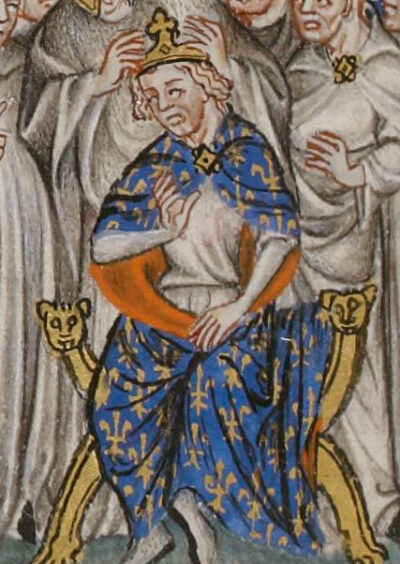
Philip V of France
Philip V of France was a King of France and Navarre (r. 1316-1322). Born 1293, in Vincennes. Died January 3, 1322, in Royal Abbey of Longchamp. Positions held include King of France (1316–1322) and Sovereign of Navarre (1316–1322).
Facts
21 facts · 1 confirmed by two sources · 7 cited · 12 from one source · 1 where the sources disagree
What’s different
- Born: we show 1293 (Sources disagree). Wikipedia says c. 1291
Where this comes from
Papalocal keeps its own record. It started from these sources; what each one said is kept here as it was copied, so a change on their side never changes this page by itself. Tap one to read its version.
What Wikidata says · copied November 16, 2026 · revision 2569219657
- Described as
- King of France and Navarre (r. 1316-1322)
- Other names
- Philip the Tall, Philippe V
- Born
- 1293 · 1 reference
- Died
- January 3, 1322 · 2 references
- Born in
- Vincennes
- Died in
- Royal Abbey of Longchamp
- Buried in
- Basilica of Saint-Denis
- Cause of death
- infection
- Citizen of
- France
- Occupation
- ruler
- Positions held
- King of France (1316–1322); Sovereign of Navarre (1316–1322)
- Spouse
- Joan II, Countess of Burgundy (1307–1322) · 2 references
- Children
- Joan III, Countess of Burgundy · 1 reference; Margaret I, Countess of Burgundy; Blanche of France; Isabella of France, Dauphine of Viennois
- Father
- Philip IV of France · 1 reference
- Mother
- Joan I of Navarre · 1 reference
- Siblings
- Isabella of France · 1 reference; Charles IV of France · 1 reference; Louis X of France · 1 reference
- Religion
- Christianity
- Wikipedias with a page
- 60
Wikidata item Q8433 (wikidata.org/wiki/Q8433), public domain (CC0). Copied November 16, 2026.
What Wikipedia says · copied November 16, 2026 · revision 1367250529
Philip V (c. 1291 – 3 January 1322), known as the Tall (French: Philippe le Long), was King of France and Navarre (as Philip II) from 1316 to 1322. Philip engaged in a series of domestic reforms intended to improve the management of the kingdom. These reforms included the creation of an independent Court of Finances, the standardization of weights and measures, and the establishment of a single currency.
Philip was the second son of King Philip IV of France and Queen Joan I of Navarre. He was granted an appanage, the County of Poitiers, while his elder brother, Louis X, inherited the French and Navarrese thrones. When Louis died in 1316, he left a daughter and a pregnant wife, Clementia of Hungary. Philip the Tall successfully claimed the regency. Queen Clementia gave birth to a boy, who was proclaimed king as John I, but the infant king lived only for four days.
At the death of his nephew, Philip immediately had himself crowned at Reims. However, his legitimacy was challenged by the party of Louis X's daughter Joan. Philip V successfully contested her claims for a number of reasons, including her youth, doubts regarding her paternity (her mother was involved in the Tour de Nesle Affair), and the Estates General's determination that women should be excluded from the line of succession to the French throne. The succession of Philip, instead of Joan, set the precedent for the French royal succession that would be known as the Salic law.
Philip restored somewhat good relations with the County of Flanders, which had entered into open rebellion during his father's rule, but simultaneously his relations with his brother-in-law Edward II of England worsened as Edward, who was also Duke of Guyenne, initially refused to pay him homage. A spontaneous popular crusade started in Normandy in 1320 aiming to liberate the Iberian Peninsula from the Moors. Instead the angry populace marched to the south attacking castles, royal officials, priests, lepers, and Jews.
In 1307 Philip married Joan II, Countess of Burgundy, with whom he had four daughters. The couple produced no male heirs, however, so when Philip died from dysentery in 1322, he was succeeded by his younger brother Charles IV.
- Born, in its opening lines
- c. 1291
- Died, in its opening lines
- January 3, 1322
From the Wikipedia article “Philip V of France” (en.wikipedia.org/wiki/Philip_V_of_France), by its contributors, under CC BY-SA 4.0 (creativecommons.org/licenses/by-sa/4.0/). Copied November 16, 2026; not changed.
Confirmed Two sources agree. Cited One source, and it names where it got it. One source One source, without a reference of its own. Sources disagree The sources disagree. We show the best-supported value and keep theirs below.
