
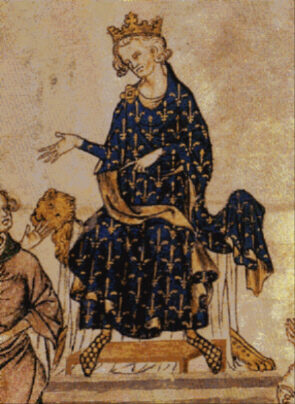
Philip VI of France
Philip VI of France was a King of France from 1328 to 1350. Born November 17, 1293, in Fontainebleau. Died August 22, 1350, in Reims. Positions held include King of France (1328–1350) and Count of Anjou.
Facts
28 facts · 2 confirmed by two sources · 6 cited · 20 from one source
Where this comes from
Papalocal keeps its own record. It started from these sources; what each one said is kept here as it was copied, so a change on their side never changes this page by itself. Tap one to read its version.
What Wikidata says · copied November 16, 2026 · revision 2569839973
- Described as
- King of France from 1328 to 1350
- Other names
- Philip VI of Valois, Philippe VI, Philippe VI de Valois, Philip VI
- Born
- November 17, 1293
- Died
- August 22, 1350 · 1 reference
- Born in
- Fontainebleau
- Died in
- Reims
- Buried in
- Basilica of Saint-Denis
- Cause of death
- plague
- Citizen of
- France
- Occupation
- sovereign
- Positions held
- King of France (1328–1350); Count of Anjou
- Spouse
- Blanche of Navarre, Queen of France (1350) · 2 references; Joan of Burgundy (1313–1349) · 2 references
- Children
- Joan of Valois; John II of France · 1 reference; Philip of Valois, Duke of Orléans · 1 reference
- Father
- Charles of Valois · 1 reference
- Mother
- Margaret, Countess of Anjou · 1 reference
- Siblings
- Charles II, Count of Alençon; Isabella of Valois, Duchess of Bourbon; Marie of Valois, Duchess of Calabria; Isabelle of Valois, Duchess of Brittany; Joan of Valois, Countess of Hainaut; Blanche of Valois; Margaret of Valois, Countess of Blois; Catherine of Valois; Joan of Valois, Countess of Beaumont; Louis of Valois · 1 reference
- Religion
- Christianity
- Wikipedias with a page
- 69
Wikidata item Q170586 (wikidata.org/wiki/Q170586), public domain (CC0). Copied November 16, 2026.
What Wikipedia says · copied November 16, 2026 · revision 1369999214
Philip VI (French: Philippe; 1293 – 22 August 1350), called the Fortunate (French: le Fortuné), the Catholic (le Catholique) and of Valois (de Valois), was the first king of France from the House of Valois, reigning from 1328 until his death in 1350. Philip's reign was dominated by the consequences of a succession dispute. When King Charles IV of France died in 1328, his nearest male relative was his sororal nephew, Edward III of England, but the French nobility preferred Charles's paternal cousin, Philip of Valois.
At first, Edward seemed to accept Philip's succession, but he pressed his claim to the throne of France after a series of disagreements with Philip. The result was the beginning of the Hundred Years' War in 1337.
After initial successes at sea, Philip's navy was annihilated at the Battle of Sluys in 1340, ensuring that the war would occur on the continent. The English took another decisive advantage at the Battle of Crécy (1346), while the Black Death struck France, further destabilising the country.
In 1349, Philip bought the Dauphiné of Viennois, a county in the Kingdom of Burgundy (Arles), under the suzerainty of the Holy Roman Empire, thus expanding the French influence beyond the river Rhône. The acquisition was formalized by the treaty of Romans, concluded between Philip and Humbert II, Dauphin of Viennois. The province was entrusted to Philip's grandson, prince Charles (the future king Charles V).
Philip VI died in 1350 and was succeeded by his son John II.
- Born, in its opening lines
- 1293
- Died, in its opening lines
- August 22, 1350
From the Wikipedia article “Philip VI of France” (en.wikipedia.org/wiki/Philip_VI_of_France), by its contributors, under CC BY-SA 4.0 (creativecommons.org/licenses/by-sa/4.0/). Copied November 16, 2026; not changed.
Confirmed Two sources agree. Cited One source, and it names where it got it. One source One source, without a reference of its own. Sources disagree The sources disagree. We show the best-supported value and keep theirs below.
