
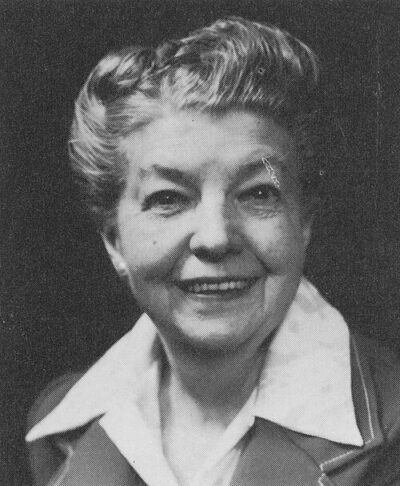
Phyllis A. Whitney
Phyllis A. Whitney was an American writer. Born September 9, 1903, in Yokohama. Died February 8, 2008, in Faber. Educated at McKinley High School. Awards include The Grand Master and Malice Domestic Award for Lifetime Achievement.
Facts
14 facts · 2 confirmed by two sources · 7 cited · 5 from one source
Where this comes from
Papalocal keeps its own record. It started from these sources; what each one said is kept here as it was copied, so a change on their side never changes this page by itself. Tap one to read its version.
What Wikidata says · copied November 16, 2026 · revision 2569189757
- Described as
- American writer
- Other names
- Phyllis Ayame Whitney
- Born
- September 9, 1903 · 6 references
- Died
- February 8, 2008 · 7 references
- Born in
- Yokohama · 1 reference
- Died in
- Faber · 1 reference
- Cause of death
- pneumonia · 1 reference
- Citizen of
- United States
- Occupation
- writer · 2 references; children's writer; novelist
- Worked for
- Chicago Public Library · 1 reference
- Education
- McKinley High School · 1 reference
- Awards
- The Grand Master (1988) · 1 reference; Malice Domestic Award for Lifetime Achievement (1990)
- Website
- http://www.phyllisawhitney.com/ · 1 reference
- Wikipedias with a page
- 21
Wikidata item Q291285 (wikidata.org/wiki/Q291285), public domain (CC0). Copied November 16, 2026.
What Wikipedia says · copied November 16, 2026 · revision 1368371238
Phyllis Ayame Whitney (September 9, 1903 – February 8, 2008) was an American mystery writer who wrote 73 novels, most all of them in the suspense and mystery genre. 39 of her books were for adults, 20 for young adults (juveniles), and 14 written for children. Her books sold millions of copies and were published in more than thirty countries.
Born in Yokohama, Japan to American parents in 1903, she spent her early years in Asia. After the death of her parents she moved to Chicago where she lived with her aunt. Later in life, Whitney moved to Staten Island, New York and resided there for 20 years with her daughter and second husband, Lovell Jahnke. Staten Island became the inspiration and setting for several of her books.
A rarity for her genre, she wrote mysteries for both the juvenile and the adult markets, many of which feature exotic settings. Although she was often described as a Gothic novelist, a review in The New York Times even dubbing her "The Queen of the American Gothics", Whitney claimed to hate this title. She preferred to say she wrote ”romantic novels of suspense".
Whitney's books were enormously popular for decades, although some critics considered her heroines too demure, the books too chaste or conservative, to which she responded in 1975 to Parade magazine (quoted in her Los Angeles Times obituary by Valerie J. Nelson), “The girls in my books are out solving their own problems. They’ve always been women’s libbers because . . . I’ve always done what I wanted to do."
In 1961, her book The Mystery of the Haunted Pool won an Edgar Award from the Mystery Writers of America for Best Juvenile Novel; she duplicated the honour in 1964 for The Mystery of the Hidden Hand. In 1988, the MWA gave her a Grand Master Award for lifetime achievement. In 1990, she received the Lifetime Achievement Award from the Romance Writers of America. Whitney also wrote three books on writing advice, including one for writing for young people. She also contributed several such articles to The Writer over the years and served on their editorial board for decades.
Whitney died of pneumonia at age 104 on February 8, 2008.
A collection of Whitney's writing, correspondence, and photographs are available at the College of Staten Island's Archives and Special Collections.
- Born, in its opening lines
- September 9, 1903
- Died, in its opening lines
- February 8, 2008
From the Wikipedia article “Phyllis A. Whitney” (en.wikipedia.org/wiki/Phyllis_A._Whitney), by its contributors, under CC BY-SA 4.0 (creativecommons.org/licenses/by-sa/4.0/). Copied November 16, 2026; not changed.
Confirmed Two sources agree. Cited One source, and it names where it got it. One source One source, without a reference of its own. Sources disagree The sources disagree. We show the best-supported value and keep theirs below.
