
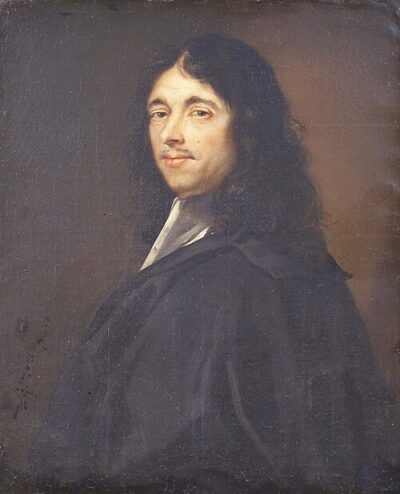
Pierre de Fermat
Pierre de Fermat was a French mathematician and lawyer. Born 1607, in Beaumont-de-Lomagne. Died January 12, 1665, in Castres. Known for Fermat's principle, Fermat's Last Theorem and Fermat's little theorem. Educated at Old University of Orléans.
Facts
26 facts · 1 confirmed by two sources · 14 cited · 10 from one source · 1 where the sources disagree
What’s different
- Born: we show 1607 (Sources disagree). Wikipedia says August 17, 1601
Where this comes from
Papalocal keeps its own record. It started from these sources; what each one said is kept here as it was copied, so a change on their side never changes this page by itself. Tap one to read its version.
What Wikidata says · copied November 16, 2026 · revision 2566594421
- Described as
- French mathematician and lawyer
- Other names
- Pierre Fermat, Fermat
- Born
- 1607 · 2 references
- Died
- January 12, 1665 · 6 references
- Born in
- Beaumont-de-Lomagne · 1 reference
- Died in
- Castres · 1 reference
- Buried in
- Castres · 1 reference
- Citizen of
- France · 1 reference
- Occupation
- mathematician · 3 references; lawyer; judge; polyglot · 1 reference; jurist · 2 references
- Worked for
- Parliament of Toulouse (1638–) · 1 reference
- Education
- Old University of Orléans (1623–1626)
- Known for
- Fermat's principle; Fermat's Last Theorem · 1 reference; Fermat's little theorem · 1 reference; Fermat point; Fermat number · 1 reference
- Field
- number theory; statute; mathematics · 1 reference; probability theory · 1 reference; mathematical analysis · 1 reference; analytic geometry · 1 reference
- Spouse
- Louise de Long (1631–) · 1 reference
- Children
- Samuel de Fermat
- Wikipedias with a page
- 114
Wikidata item Q75655 (wikidata.org/wiki/Q75655), public domain (CC0). Copied November 16, 2026.
What Wikipedia says · copied November 16, 2026 · revision 1380928564
Pierre de Fermat (; French: [pjɛʁ də fɛʁma]; 17 August 1601 – 12 January 1665) was a French magistrate, polymath, and mathematician credited for early developments that led to infinitesimal calculus, including his technique of adequality. In particular, he is recognized for his discovery of an original method of finding the greatest and the smallest ordinates of curved lines, which is analogous to that of differential calculus, then unknown, and his research into number theory. He made notable contributions to analytic geometry, probability, and optics. He is best known for his Fermat's principle for light propagation and his Fermat's Last Theorem in number theory, which he described in a note at the margin of a copy of Diophantus' Arithmetica. He was also a lawyer at the parlement of Toulouse, France, a poet, a skilled Latinist, and a Hellenist.
- Born, in its opening lines
- August 17, 1601
- Died, in its opening lines
- January 12, 1665
From the Wikipedia article “Pierre de Fermat” (en.wikipedia.org/wiki/Pierre_de_Fermat), by its contributors, under CC BY-SA 4.0 (creativecommons.org/licenses/by-sa/4.0/). Copied November 16, 2026; not changed.
Confirmed Two sources agree. Cited One source, and it names where it got it. One source One source, without a reference of its own. Sources disagree The sources disagree. We show the best-supported value and keep theirs below.
