
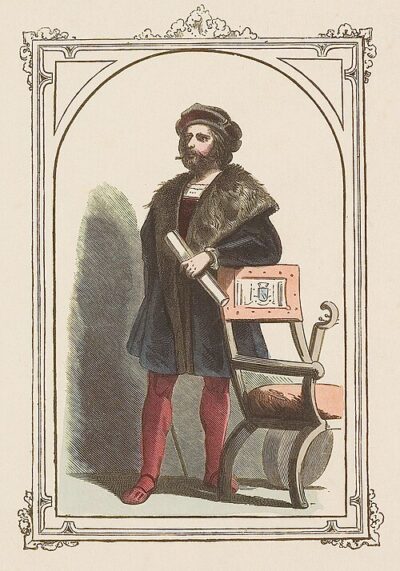
Pierre de la Rue
Pierre de la Rue was a Franco-Flemish Renaissance singer, composer. Born 1460, in Tournai. Died November 20, 1518, in Kortrijk. Educated at Tournai Cathedral.
Facts
7 facts · 1 confirmed by two sources · 4 cited · 1 from one source · 1 where the sources disagree
What’s different
- Born: we show 1460 (Sources disagree). Wikipedia says c. 1452
Where this comes from
Papalocal keeps its own record. It started from these sources; what each one said is kept here as it was copied, so a change on their side never changes this page by itself. Tap one to read its version.
What Wikidata says · copied November 17, 2026 · revision 2568062172
- Described as
- Franco-Flemish Renaissance singer, composer
- Born
- 1460 · 7 references
- Died
- November 20, 1518 · 2 references
- Born in
- Tournai · 1 reference
- Died in
- Kortrijk · 1 reference
- Citizen of
- Southern Netherlands · 1 reference
- Occupation
- composer · 1 reference
- Education
- Tournai Cathedral
- Wikipedias with a page
- 27
Wikidata item Q370540 (wikidata.org/wiki/Q370540), public domain (CC0). Copied November 17, 2026.
What Wikipedia says · copied November 17, 2026 · revision 1348550783
Pierre de la Rue (c. 1452 – 20 November 1518) was a Franco-Flemish composer and singer of the Renaissance. His name also appears as Piersson or variants of Pierchon and his toponymic, when present, as various forms of de Platea, de Robore, or de Vico. A member of the same generation as Josquin des Prez, and a long associate of the Habsburg-Burgundian musical chapel, he ranks with Agricola, Brumel, Compère, Isaac, Obrecht, and Weerbeke as one of the most famous and influential composers in the Netherlands polyphonic style in the decades around 1500.
- Born, in its opening lines
- c. 1452
- Died, in its opening lines
- November 20, 1518
From the Wikipedia article “Pierre de la Rue” (en.wikipedia.org/wiki/Pierre_de_la_Rue), by its contributors, under CC BY-SA 4.0 (creativecommons.org/licenses/by-sa/4.0/). Copied November 17, 2026; not changed.
Confirmed Two sources agree. Cited One source, and it names where it got it. One source One source, without a reference of its own. Sources disagree The sources disagree. We show the best-supported value and keep theirs below.
