
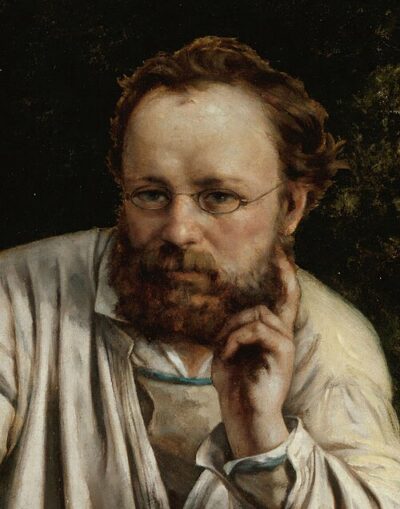
Pierre-Joseph Proudhon
Pierre-Joseph Proudhon was a French politician, philosopher, anarchist and socialist. Born January 15, 1809, in Besançon. Died January 19, 1865, in Passy. Positions held include Member of the 1848 Constituent Assembly (1848–1849). Known for What Is Property?, The Confessions of a Revolutionary and The System of Economic Contradictions, or The Philosophy of Poverty.
Facts
31 facts · 2 confirmed by two sources · 9 cited · 20 from one source
Where this comes from
Papalocal keeps its own record. It started from these sources; what each one said is kept here as it was copied, so a change on their side never changes this page by itself. Tap one to read its version.
What Wikidata says · copied November 16, 2026 · revision 2565595970
- Described as
- French politician, philosopher, anarchist and socialist (1809-1865)
- Other names
- P.-J. Proudhon, Pierre Joseph Proudhon, Pʹer Zhozef Prudon, Pʻu-lu-tung, Purūdon
- Born
- January 15, 1809 · 13 references
- Died
- January 19, 1865 · 12 references
- Born in
- Besançon · 5 references
- Died in
- Passy
- Buried in
- Montparnasse Cemetery
- Citizen of
- France · 4 references; Belgium · 1 reference
- Occupation
- economist; sociologist; politician; journalist; philosopher · 5 references; writer · 1 reference; printer · 1 reference; Master's Degree in Economics · 2 references
- Positions held
- Member of the 1848 Constituent Assembly (1848–1849)
- Political party
- The Mountain (1849–1852) · 1 reference
- Known for
- What Is Property?; The Confessions of a Revolutionary; The System of Economic Contradictions, or The Philosophy of Poverty; The General Idea of the Revolution in the Nineteenth Century; social federalism
- Field
- philosophy; liberty · 1 reference; ownership · 1 reference; power · 1 reference; poverty · 1 reference; social justice · 1 reference
- Spouse
- Euphrasie Proudhon (1849–) · 2 references
- Children
- Catherine Henneguy · 1 reference
- Religion
- atheism
- Wikipedias with a page
- 108
Wikidata item Q5749 (wikidata.org/wiki/Q5749), public domain (CC0). Copied November 16, 2026.
What Wikipedia says · copied November 16, 2026 · revision 1384900566
Pierre-Joseph Proudhon (, also US: ; French: [pjɛʁ ʒozɛf pʁudɔ̃]; 15 January 1809 – 19 January 1865) was a French anarchist, socialist, philosopher, and economist who founded mutualist philosophy and is considered by many to be the "father of anarchism". He was the first person known to self-identify as an anarchist, and is widely regarded as one of anarchism's most influential theorists. Proudhon became a member of the French Parliament after the Revolution of 1848, whereafter he referred to himself as a federalist. Proudhon described the liberty he pursued as the synthesis of community and individualism. Some consider his mutualism to be part of individualist anarchism while others regard it to be part of social anarchism.
Proudhon, who was born in Besançon, was a printer who taught himself Latin in order to better print books in the language. His best-known assertion is that "property is theft!", contained in his first major work, What Is Property? Or, an Inquiry into the Principle of Right and Government (Qu'est-ce que la propriété? Recherche sur le principe du droit et du gouvernement), published in 1840. The book's publication attracted the attention of the French authorities. It also attracted the scrutiny of Karl Marx, who started a correspondence with its author. The two influenced each other and they met in Paris while Marx was exiled there. Their friendship finally ended when Marx responded to Proudhon's The System of Economic Contradictions, or The Philosophy of Poverty with the provocatively titled The Poverty of Philosophy. The dispute became one of the sources of the split between the anarchist and Marxist wings of the International Working Men's Association. Some, such as Edmund Wilson, have contended that Marx's attack on Proudhon had its origin in the latter's defense of Karl Grün, whom Marx bitterly disliked, but who had been preparing translations of Proudhon's work.
Proudhon favored workers' councils and associations or cooperatives as well as individual worker/peasant possession over private ownership or the nationalization of land and workplaces. He considered social revolution to be achievable in a peaceful manner. Proudhon unsuccessfully tried to create a national bank, to be funded by what became an abortive attempt at an income tax on capitalists and shareholders. Similar in some respects to a credit union, it would have given interest-free loans. After the death of his follower Mikhail Bakunin, Proudhon's libertarian socialism diverged into individualist anarchism, collectivist anarchism, anarcho-communism and anarcho-syndicalism, with notable proponents such as Carlo Cafiero, Joseph Déjacque, Peter Kropotkin and Benjamin Tucker.
- Born, in its opening lines
- January 15, 1809
- Died, in its opening lines
- January 19, 1865
From the Wikipedia article “Pierre-Joseph Proudhon” (en.wikipedia.org/wiki/Pierre-Joseph_Proudhon), by its contributors, under CC BY-SA 4.0 (creativecommons.org/licenses/by-sa/4.0/). Copied November 16, 2026; not changed.
Confirmed Two sources agree. Cited One source, and it names where it got it. One source One source, without a reference of its own. Sources disagree The sources disagree. We show the best-supported value and keep theirs below.
