
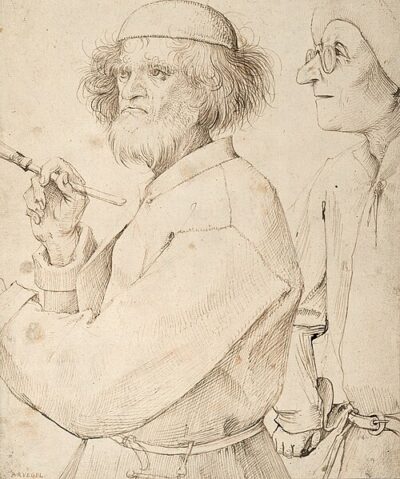
Pieter Bruegel the Elder
Pieter Bruegel the Elder was a Flemish painter. Born 1525, in Breda. Died September 9, 1569, in Brussels. Known for Two Chained Monkeys, Dull Gret and The Peasant Dance.
Facts
23 facts · 0 confirmed by two sources · 14 cited · 9 from one source
Where this comes from
Papalocal keeps its own record. It started from these sources; what each one said is kept here as it was copied, so a change on their side never changes this page by itself. Tap one to read its version.
What Wikidata says · copied November 16, 2026 · revision 2568677787
- Described as
- Flemish painter (1526–1569)
- Other names
- Old Breugel, Pieter I Bruegel, Pieter Breughel the Elder, Pierre Bruegel, Pieter, I Breugel, Pieter Brueghel I, Pieter, I Bruegel, Old Breughel, Pieter, I Brueghel, Boeren Brueghel, Pieter, I Breughel, Peter Brueghel
- Born
- 1525 · 11 references
- Died
- September 9, 1569 · 2 references
- Born in
- Breda · 2 references
- Died in
- Brussels · 2 references
- Buried in
- Church of Our Lady of the Chapel
- Citizen of
- Duchy of Brabant
- Occupation
- painter · 6 references; printmaker · 3 references; draftsperson · 3 references
- Member of
- Antwerp Guild of Saint Luke
- Genre
- Northern Renaissance; landscape painting · 1 reference; portrait · 1 reference; still life · 1 reference; animal art · 1 reference; marine art · 1 reference
- Known for
- Two Chained Monkeys; Dull Gret; The Peasant Dance
- Field
- Renaissance painting
- Spouse
- Mayken Coecke (1563–)
- Children
- Pieter Brueghel the Younger · 1 reference; Jan Brueghel the Elder · 1 reference
- Wikipedias with a page
- 92
Wikidata item Q43270 (wikidata.org/wiki/Q43270), public domain (CC0). Copied November 16, 2026.
What Wikipedia says · copied November 16, 2026 · revision 1384345445
Pieter Bruegel (also Brueghel or Breughel) the Elder ( BROY-gəl, US also BROO-gəl; Dutch: [ˈpitər ˈbrøːɣəl] ; c. 1525–1530 – 9 September 1569) was among the most significant artists of Dutch and Flemish Renaissance painting, a painter and printmaker, known for his landscapes and peasant scenes (so-called genre painting); he was a pioneer in presenting both types of subject as large paintings. In the 20th and 21st centuries, Bruegel works including Landscape with the Fall of Icarus (c. 1560) and The Hunters in the Snow (1565) have inspired artists in both the literary arts and in cinema.
He was a formative influence on Dutch Golden Age painting and later painting in general in his innovative choices of subject matter, as one of the first generation of artists to grow up when religious subjects had ceased to be the natural subject matter of painting. He also painted no portraits, the other mainstay of Netherlandish art. After his training and travels to Italy, he returned in 1555 to settle in Antwerp, where he worked mainly as a prolific designer of prints for the leading publisher of the day. At the end of the 1550s, he made painting his main medium, and all his famous paintings come from the following period of little more than a decade before his early death in 1569, when he was probably in his early forties.
From the Wikipedia article “Pieter Bruegel the Elder” (en.wikipedia.org/wiki/Pieter_Bruegel_the_Elder), by its contributors, under CC BY-SA 4.0 (creativecommons.org/licenses/by-sa/4.0/). Copied November 16, 2026; not changed.
Confirmed Two sources agree. Cited One source, and it names where it got it. One source One source, without a reference of its own. Sources disagree The sources disagree. We show the best-supported value and keep theirs below.
