
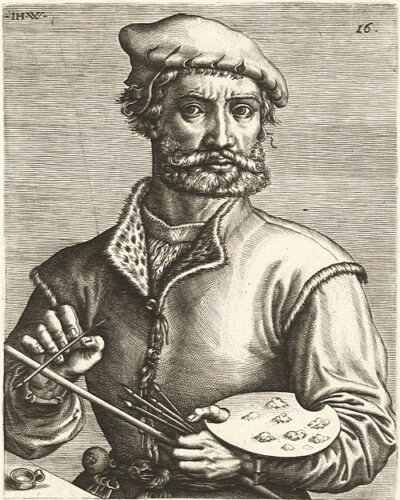
Pieter Coecke van Aelst
Pieter Coecke van Aelst was a Flemish painter painter, sculptor, architect, author and designer of woodcuts, goldsmith's work, stained glass and tapestries. Born August 14, 1502, in Aalst. Died December 6, 1550, in Brussels. Known for Triptych with Adoration of the Magi, The Holy Family and Triptych of Nava and Grimon.
Facts
23 facts · 2 confirmed by two sources · 12 cited · 9 from one source
Where this comes from
Papalocal keeps its own record. It started from these sources; what each one said is kept here as it was copied, so a change on their side never changes this page by itself. Tap one to read its version.
What Wikidata says · copied November 17, 2026 · revision 2564771602
- Described as
- Flemish painter painter, sculptor, architect, author and designer of woodcuts, goldsmith's work, stained glass and tapestries (1502–1550)
- Other names
- Pieter Koecke van Aalst, Master of the Last Supper, Pieter, I Coeck van Alost, Pieter I Cock, Pieter, I Coeke van Aelst, Pieter I Koecke Van Aelst, Pieter Coek, Pieter, I Koecke van Aelst, Pieter, I Coecke, Pieter I Coecke, Pieter, Pierre Koeck
- Born
- August 14, 1502 · 3 references
- Died
- December 6, 1550 · 7 references
- Born in
- Aalst · 1 reference
- Died in
- Brussels · 2 references
- Citizen of
- Southern Netherlands
- Occupation
- painter · 3 references; architect · 2 references; translator · 1 reference; sculptor · 1 reference; graphic artist · 1 reference; artist · 1 reference; engraver · 1 reference
- Member of
- Antwerp Guild of Saint Luke (1527–)
- Genre
- Renaissance
- Known for
- Triptych with Adoration of the Magi; The Holy Family; Triptych of Nava and Grimon; Triptych: Adoration of the Magi; Annunciation; Rest on the flight into Egypt · 1 reference
- Spouse
- Mayken Verhulst (1538–1550) · 1 reference
- Children
- Pauwels Coecke van Aelst · 3 references; Mayken Coecke; Pieter Coecke van Aelst (II) · 1 reference
- Father
- Pieter van Aelst
- Wikipedias with a page
- 26
Wikidata item Q434006 (wikidata.org/wiki/Q434006), public domain (CC0). Copied November 17, 2026.
What Wikipedia says · copied November 17, 2026 · revision 1374151827
Pieter Coecke van Aelst or Pieter Coecke van Aelst the Elder (14 August 1502 – 6 December 1550) was a Flemish painter, sculptor, architect, author and designer of woodcuts, goldsmith's work, stained glass and tapestries. His principal subjects were Christian religious themes. He hailed from the Duchy of Brabant, worked in Antwerp and Brussels, and was appointed court painter to Charles V, Holy Roman Emperor.
Coecke van Aelst was a polyglot. He published translations into Flemish (Dutch), French and German of Ancient Roman and modern Italian architectural treatises. These publications played a pivotal role in the dissemination of Renaissance ideas in Northern Europe. They contributed to the transition in Northern Europe from the late Gothic style then prevalent towards a modern 'antique-oriented' architecture.
- Born, in its opening lines
- August 14, 1502
- Died, in its opening lines
- December 6, 1550
From the Wikipedia article “Pieter Coecke van Aelst” (en.wikipedia.org/wiki/Pieter_Coecke_van_Aelst), by its contributors, under CC BY-SA 4.0 (creativecommons.org/licenses/by-sa/4.0/). Copied November 17, 2026; not changed.
Confirmed Two sources agree. Cited One source, and it names where it got it. One source One source, without a reference of its own. Sources disagree The sources disagree. We show the best-supported value and keep theirs below.
